
 Dr. Essam Al-Barram
The employment of symbolism and myth in modern Arabic poetry represents one of the most significant features of its radical transformation from its classical forms. Poetry is no longer merely a direct expression of emotion or a record of events; rather, it has become an intellectual and aesthetic act that seeks to reinterpret existence, the self, and history. In this context, the names of Adonis and Badr Shakir Al-Sayyab stand out as two of the most influential poets in establishing the symbolic and mythological dimension of the modern Arabic poem, each according to his own approach, vision, and existential and intellectual concerns.
This transformation emerged during a period of profound political and cultural crisis in the Arab world, when direct language appeared incapable of encompassing both the magnitude of collapse and the hope that persisted alongside it. Symbolism and myth therefore became an alternative language capable of transcending both external and internal censorship while opening the poetic text to multiple layers of meaning. The poet no longer spoke solely in an individual voice but instead borrowed the voices of ancient gods, mythical heroes, and historical figures to express the modern Arab individual in his anxiety, alienation, and aspiration for redemption.
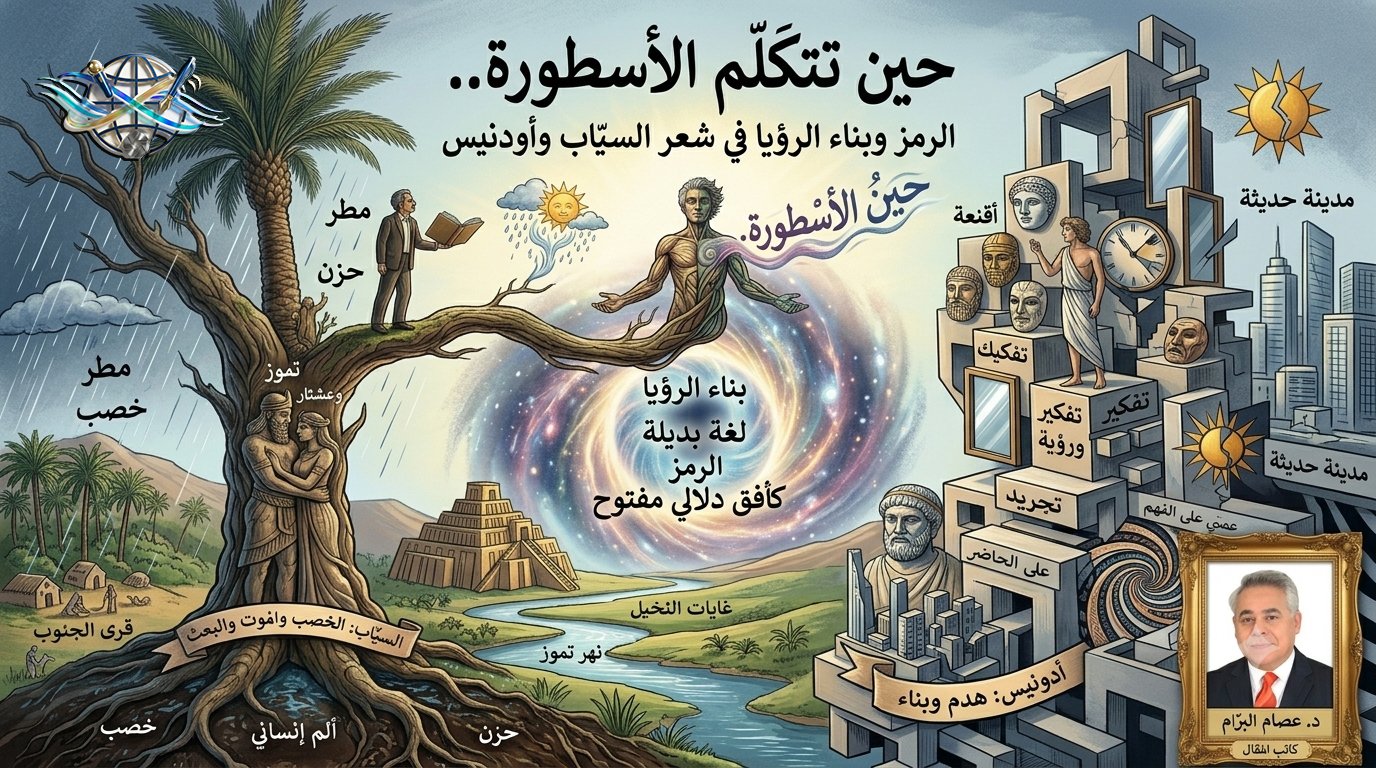
Al-Sayyab was among the first poets to incorporate myth organically into the structure of the Arabic poem, closely linking it to lived experience and social reality. In his poetry, personal suffering stands alongside collective tragedy, while myth becomes a mirror reflecting human pain. Al-Sayyab drew inspiration from myths of fertility, death, and resurrection, such as the myths of Tammuz and Ishtar, to express the idea of rebirth after devastation and the dream of a new beginning for a homeland burdened with wounds. For him, myth was neither a cultural luxury nor a linguistic ornament; it was an artistic and intellectual necessity imposed by the harsh realities experienced by Iraq during that period.
In Al-Sayyab’s poems, rain becomes a central symbol bearing contradictory meanings. It is a sign of fertility and life, yet at the same time a witness to sorrow and loss. This multiplicity of meanings reflects the symbol’s ability to embrace human contradiction, which gave his poetry remarkable depth and influence. Here, myth is inseparable from the local environment; it intertwines with palm trees, rivers, and the villages of southern Iraq to create a poetic world that blends the universal with the local and the human with the metaphysical.
As for Adonis, he transformed symbolism and myth into a comprehensive intellectual and aesthetic project aimed at reconstructing Arabic poetry from its very roots. For him, myth is not merely a means of expression but a structure of thought and a vision of the world. Adonis invoked Eastern and Western myths, as well as historical and religious figures, deconstructing and reconstructing them within a modernist context that challenges the established order while raising profound questions about authority, knowledge, identity, and time. In his poetry, mythical figures become masks through which the poet speaks—not to narrate the past, but to judge the present and anticipate the future.
Adonis employs symbolism as a means of breaking away from direct language and traditional rhetoric. His language is dense and open to interpretation, requiring an active reader who participates in the creation of meaning. For him, myth does not offer salvation as much as it exposes the existential dilemma and lays bare rigid intellectual structures. Consequently, his poetry appears more abstract and less connected to everyday events than that of Al-Sayyab, yet more deeply immersed in philosophical and universal questions.
Between Al-Sayyab and Adonis emerge two distinct schools in the employment of symbolism and myth. Al-Sayyab begins with personal and collective suffering and arrives at myth as a source of consolation and hope, whereas Adonis begins with myth in order to dismantle reality and radically question it. Nevertheless, both share a profound awareness of the inability of traditional language to express a turbulent age and strive to create a new poetic language that transcends description in favor of vision.
In their poetry, symbolism is not an end in itself nor an exercise in deliberate obscurity; rather, it is an open horizon of meaning that liberates the poem from singularity and grants it continuity and renewal. A symbolic poem is not exhausted by a single reading but recreates its meaning with every new reading. This explains why the poetry of Al-Sayyab and Adonis has remained alive in critical and cultural memory despite changing times and contexts.
The impact of this symbolic and mythological employment was not confined to their individual experiences; it extended to subsequent generations of Arab poets who found in myth a fertile field for experimentation and the breaking of conventional forms. Together, they contributed to moving poetry from the realm of emotional expression to the realm of vision and interpretation, and from the individual voice to the universal voice.
From this perspective, it can be said that symbolism and myth in the poetry of Adonis and Al-Sayyab are not merely two literary techniques, but rather expressions of a new awareness of poetry and its function. It is poetry that refuses to be a superficial mirror of reality and instead seeks to deepen it and reimagine it. Between the myth of fertility in Al-Sayyab’s poetry and the myths of destruction and reconstruction in Adonis’s work, the features of modern Arabic poetry take shape as a space for questioning, difference, and the continuous search for the meaning of humanity in a changing world.
To deepen the reading of symbolism and myth in the works of Al-Sayyab and Adonis, it is necessary to consider the historical and intellectual dimension that made the return to myth a modernist act rather than a retreat into the past. In modern poetry, myth was not invoked as a primitive tale or the remnants of ancient beliefs, but as an open human text that carries archetypal patterns of human experience capable of being reinterpreted in light of the present. Thus, both poets approached myth with a critical awareness that recreated it within a new poetic structure, one that transcended repetition and established difference.
The Myth Between Historical Consciousness and Existential Anxiety
In Al-Sayyab’s poetry, symbolism and myth acquire a historical dimension closely linked to the question of Arab defeat and the dream of renaissance. He was a poet who lived through intense political transformations and major disappointments, witnessing the contradiction between revolutionary promises and harsh reality. Consequently, myth in his work is charged with a redemptive energy, even in moments of despair. Tammuz, who dies and is reborn, and Ishtar, who descends into the underworld, are not merely aesthetic symbols but expressions of a profound belief in the cycle of life and in a hope that never fades despite suffering. Here, myth becomes one with ordinary human experience, granting it a universal dimension without stripping it of its emotional warmth.
The religious and spiritual dimension in Al-Sayyab’s poetry also intersects with myth without dissolving into it. There is a clear tragic sensibility that makes symbolism a means of questioning justice, fate, and human suffering. This gives his poetry the power to produce an immediate emotional impact despite the richness of its symbolic language. The reader does not feel alienated before the text but instead finds himself immersed in both its pain and its hope.
As for Adonis, his use of myth stems from a profound intellectual and philosophical anxiety. He is a poet who views history as a structure open to deconstruction rather than as a sacred narrative. For this reason, he rereads myths and religious and historical symbols in order to expose the authority and dominant discourse embedded within them. For him, myth is not a promise of salvation but an open question about the meaning of beginnings and endings, and about the possibility of genuine renewal. Consequently, his poetry often appears startling or resistant to immediate understanding because it offers the reader no ready-made answers but instead compels doubt and renewed reflection.
In Adonis’s poetry, poetic language itself performs a mythic function. Words become living entities that are dismantled and reconstructed beyond their familiar contexts. Here, the symbol does not point to a fixed meaning but to a network of shifting relationships and evolving significations. This transforms his poetry into an open interpretive space that transcends both time and place.
It is noteworthy that both poets employed myth to establish a break with traditional poetic discourse, yet each chose a different path. Al-Sayyab reconnected poetry with ordinary people and their daily suffering through transparent symbolism closely tied to universal human sensibility, whereas Adonis intensified the complexity of the poetic experience, turning it into an intellectual and aesthetic laboratory. This difference does not represent a contradiction so much as it reflects the diversity of possibilities that symbolism and myth offer in expressing the modern Arab experience.
A broader examination of the works of Al-Sayyab and Adonis reveals that symbolism and myth were not merely a transitional phase in the evolution of Arabic poetry, but became a lasting horizon for modern writing. They liberated the poem from the confines of direct expression and opened before it a universal space that enabled dialogue with other cultures without sacrificing its own distinct identity. Through this profound employment of myth, modern Arabic poetry was able to express both its crisis and its aspirations, proving that poetry remains capable of creating meaning in a turbulent and ever-changing world.
Discover more from المنتدى الدولى للصحافة والإعلام
Subscribe to get the latest posts sent to your email.