
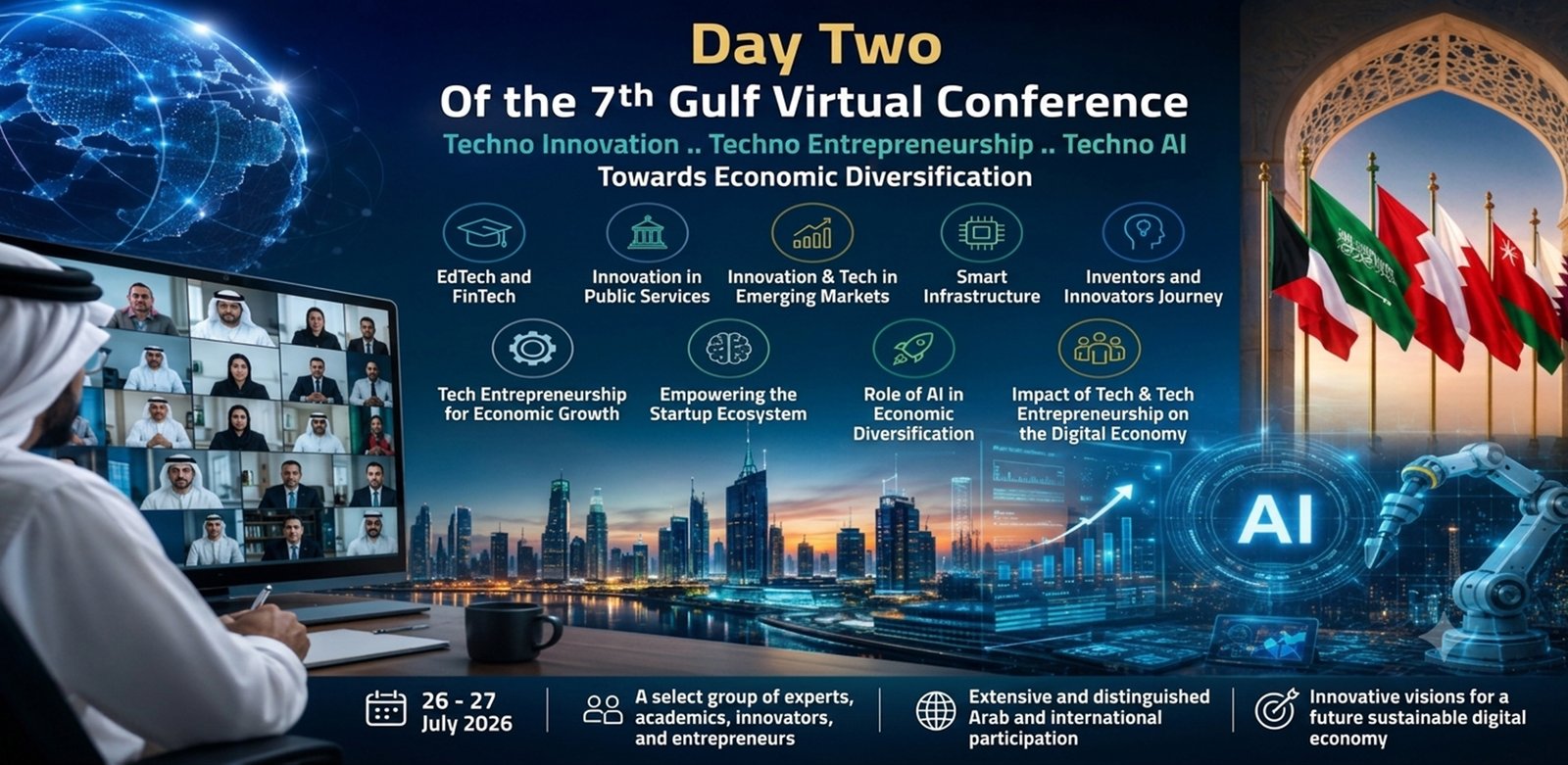
The second day of the Seventh Gulf Virtual Conference “Techno Innovation, Techno Entrepreneurship, Techno Artificial Intelligence Towards Economic Diversification” continued, with the participation of a distinguished group of experts, academics, researchers, consultants, entrepreneurs, and innovators from various Arab and international countries, in a diverse scientific program that presented new visions and experiences on the future of technology, innovation, and digital transformation and their role in supporting development and economic diversification.
Second-Day Topics and Expert Participation
The scientific program of the second day opened with a discussion of the topic of Innovation and Technology in Emerging Markets, with the participation of Dr. Abdullah Kamal from the State of Kuwait, Regional Director of Business Development, and Engineer Yousuf Al-Shatti, Patent Examiner at the Sabah Al-Ahmad Center for Giftedness and Creativity. The session was moderated by Dr. Hassan Al-Bahrani from Kuwait.
The topic of Innovation and Technology in Public Services addressed ways to develop government services and employ innovative solutions to improve performance and services, with the participation of Dr. Mona Al-Dosari from the Kingdom of Saudi Arabia, Vice Dean of the College of Engineering at Sultan Abdulaziz University, and Dr. Iman Al-Tamimi from the State of Qatar, Information Systems Consultant at the Civil Service Bureau. The session was moderated by Dr. Moanes Shujaa from the United Arab Emirates, Executive Director of MARZ Group.
The topic of Educational Technology and Financial Technology also discussed the latest digital transformations in the education and financial sectors, with the participation of Dr. Hassan Youssef from Egypt, Head of the Indonesian Research Center, and Dr. Ninat Kamel from Lebanon, Educational Technology Consultant. The session was moderated by Dr. Amani Basha from Egypt, Professor of Media.
The topic of Smart Infrastructure reviewed the importance of developing digital infrastructure and its role in supporting development and building smart cities and services, with the participation of Dr. Mohamed Abu El-Soud from Egypt, Innovation and Digital Transformation Consultant, and Dr. Zaid Al-Fuqaha from Jordan, Professor at the University of Jordan. The session was moderated by Dr. Hayat Omri from Tunisia, International Expert.
The topic of the Journey of Inventors and Innovators addressed the stories and experiences of innovators and those with innovative ideas, as well as the challenges they faced in transforming ideas into viable projects and applicable solutions, with the participation of Dr. Sari Al-Lahham from Palestine, Periodontics and Bone Surgery Specialist, and Dr. Najlaa Al-Raddadi from the Kingdom of Saudi Arabia, Professor of Inorganic and Nanochemistry at Taibah University. The session was moderated by Dr. Khadija Al-Zaidi from Saudi Arabia, Empowerment Consultant.
The conference dedicated a topic on Technological Entrepreneurship for Economic Growth to discussing the role of technological ideas and projects in supporting the economy and promoting innovation and growth, with the participation of Dr. Mahmoud Rawajiah from the Kingdom of Saudi Arabia, International Innovation Consultant, and Dr. Jaafar Hamza from Bahrain, Brand Strategist. The session was moderated by Dr. Saleh Al-Oyaini from Saudi Arabia, Professor at Imam Muhammad ibn Saud Islamic University.
The topic of Empowering the Startup Ecosystem also examined mechanisms for developing the business environment, supporting technological projects, and empowering entrepreneurs, with the participation of Dr. Nizar Sami from Egypt, Skills Development Expert at the United Nations Development Programme, and Dr. Mohamed Al-Tawil, Technology Consultant. The session was moderated by Dr. Jehan Khalifa, Dean of the College of Applied Studies at IPEX Global University.
Under the topic of The Role of Artificial Intelligence in Economic Diversification, participants discussed opportunities for employing smart technologies and modern data to support economic development and build a more competitive economy, with the participation of Dr. Osama Al-Dhargham from Jordan, Dean of the Faculty of Communications and Information Technology, and Dr. Salem Al-Shuaili from the Sultanate of Oman, Digital Transformation and Big Data Expert. The session was moderated by Dr. Hala Ali from Egypt, Professor of Public Relations.
The scientific program of the second day concluded with a discussion of the topic of The Impact of Techno-Innovation and Technological Entrepreneurship on the Digital Economy, with the participation of Dr. Zakaria Fawzi from Egypt, Expert at the National Research Center, and Dr. Manal Al-Asas from Jordan, Consultant at the International Organization IWPG. The session was moderated by Dr. Laila Al-Harbi from the Kingdom of Saudi Arabia.
International and Specialized Diversity
The second day was characterized by clear diversity in the nationalities and specializations of the participants, as the program brought together academic, research, and consulting expertise, technology and digital transformation, entrepreneurship and innovation, media and public relations, artificial intelligence, and big data.
This diversity added special intellectual value to the second-day sessions by presenting multiple experiences and different perspectives on the challenges faced by modern economies and the opportunities provided by technology to develop public services, education, the financial sector, infrastructure, startups, and the digital economy.
The diversity of participation also reflected the broad scope of the conference and its ability to bring together Arab and international expertise on a single platform, thereby enhancing the exchange of knowledge and experience and opening the way for building future partnerships in the fields of innovation, technology, and development.
Appreciation for Professionalism and Organization
The second day of the conference deserved recognition for the scientific and professional diversity it presented, the wide range of expertise and experiences, and the high standard of session organization and management, confirming the conference’s success in delivering an integrated program that combined scientific and practical aspects.
In this context, the efforts of Dr. Hanadi Mubarak Al-Mubarki, President of the Conference, stood out in leading the conference activities and overseeing its organization, as well as bringing together this distinguished group of experts and specialists from different countries, which contributed to presenting diverse scientific content that discussed issues of technology, innovation, entrepreneurship, and artificial intelligence from multiple perspectives.
The second day confirmed that the conference did not merely present technological developments, but rather sought to connect technology with the economy and development, transform innovation into practical opportunities, support entrepreneurs and startups, and promote the use of artificial intelligence in building knowledge-based economies.
These activities came as an extension of the conference’s mission to promote cooperation and exchange expertise, and to build knowledge bridges between academic, research, economic, and technological institutions, in a manner that served the future of sustainable development in the region.
Conclusion of the Second Day
The conclusion of the second day of the conference affirmed the importance of continuing Arab and international dialogue on the future of technology, innovation, and artificial intelligence, and the need to transform shared knowledge and expertise into initiatives, partnerships, and practical solutions that support development and contribute to building a more innovative and sustainable digital economy.
Discover more from المنتدى الدولى للصحافة والإعلام
Subscribe to get the latest posts sent to your email.