
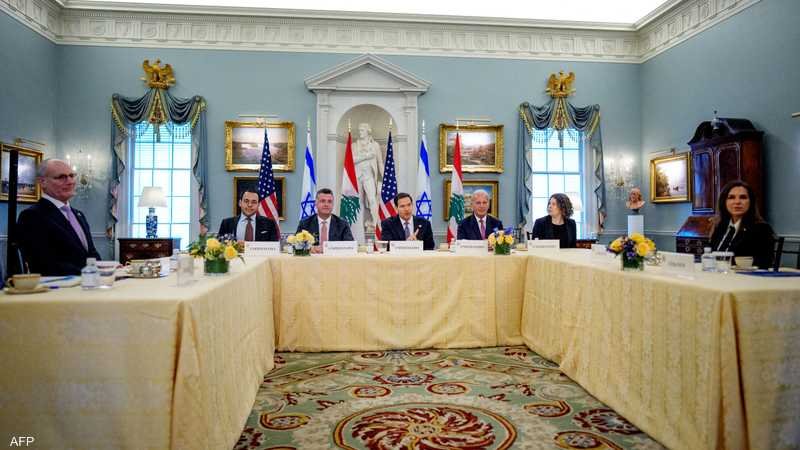
Lebanon and Israel are set to begin, on Tuesday in Washington, a fifth round of direct talks, as Beirut remains committed to continuing negotiations, despite what sources describe as the growing impact of U.S.–Iran understandings on the negotiation track, which has weakened Lebanon’s position.
Lebanese officials maintain that direct talks with Israel are the only path to ending the ongoing war that has continued since March 2.
Four previous rounds of Lebanese–Israeli talks, which began in April, have failed to reach a lasting ceasefire.
Meanwhile, this week has seen the longest period of calm since the outbreak of fighting, following a U.S.–Iran memorandum of understanding that calls for a halt to hostilities on all fronts, including Lebanon.
According to a Lebanese official and foreign officials involved in Lebanese affairs cited by Reuters, the U.S.–Iran agreement has strengthened Hezbollah, which is backed by Tehran, and shifted leverage away from the Lebanese state, leaving it in its weakest position so far and raising questions about the usefulness of the new round of talks.
The Lebanese official expressed skepticism that the three-day negotiations would produce any tangible progress, saying: “There is still a fundamental trust problem between us and the Israelis in these talks. We cannot meet their demands, and they reject all of ours.”
He added that Lebanon will push during the talks for a “reasonable” timetable for the withdrawal of Israeli forces from southern Lebanon, one of Beirut’s key objectives, although Israeli officials insist troops will remain in southern Lebanon indefinitely.
“This is our only opportunity to generate momentum in these talks and in this conflict with Iran,” he said.
On the other hand, Israel sees the upcoming talks as aimed at “disarming Hezbollah and reaching a genuine peace agreement” with Lebanon, according to Israeli government spokesperson David Mencer on the eve of the new round.
Mencer said Hezbollah is the only obstacle to an agreement with Lebanon, adding: “That is why we believe it must be disarmed and dismantled.”
The Lebanese government has approached the issue of Hezbollah’s disarmament cautiously since 2025, fearing that any direct move against the group could trigger a civil conflict.
Hezbollah, for its part, refuses to fully relinquish its weapons, while Lebanon’s government has called for refraining from direct negotiations with Israel.
Israeli public broadcaster Kan reported that the new round of talks will begin Tuesday, aiming to outline preliminary details for the withdrawal of Israeli forces from southern Lebanon as part of implementing a pilot project for the Lebanese army.
The talks will follow a similar format, mediated by the United States and attended by the Israeli and Lebanese ambassadors, along with three brigadier generals.
Israeli officials told Kan that among the considerations is the possibility that the Israeli army may be asked, under a U.S. decision, to gradually withdraw from some areas in the Israeli security belt, located deep inside the zone, allowing the Lebanese army to return as a confidence-building step.
Over the past 24 hours, and pending political decisions, the Israeli army has begun repositioning its forces and reorganizing troops deployed on the ground.
The Israeli military estimates that armed fighters are still trapped within the approximately 600-kilometer security belt area.
The army says there are no restrictions on eliminating threats targeting its forces, although a significant portion of planned operations, such as those in the Al-Tayr Heights, have been halted.
Discover more from المنتدى الدولى للصحافة والإعلام
Subscribe to get the latest posts sent to your email.