
Report: Soha El-Baghdadi
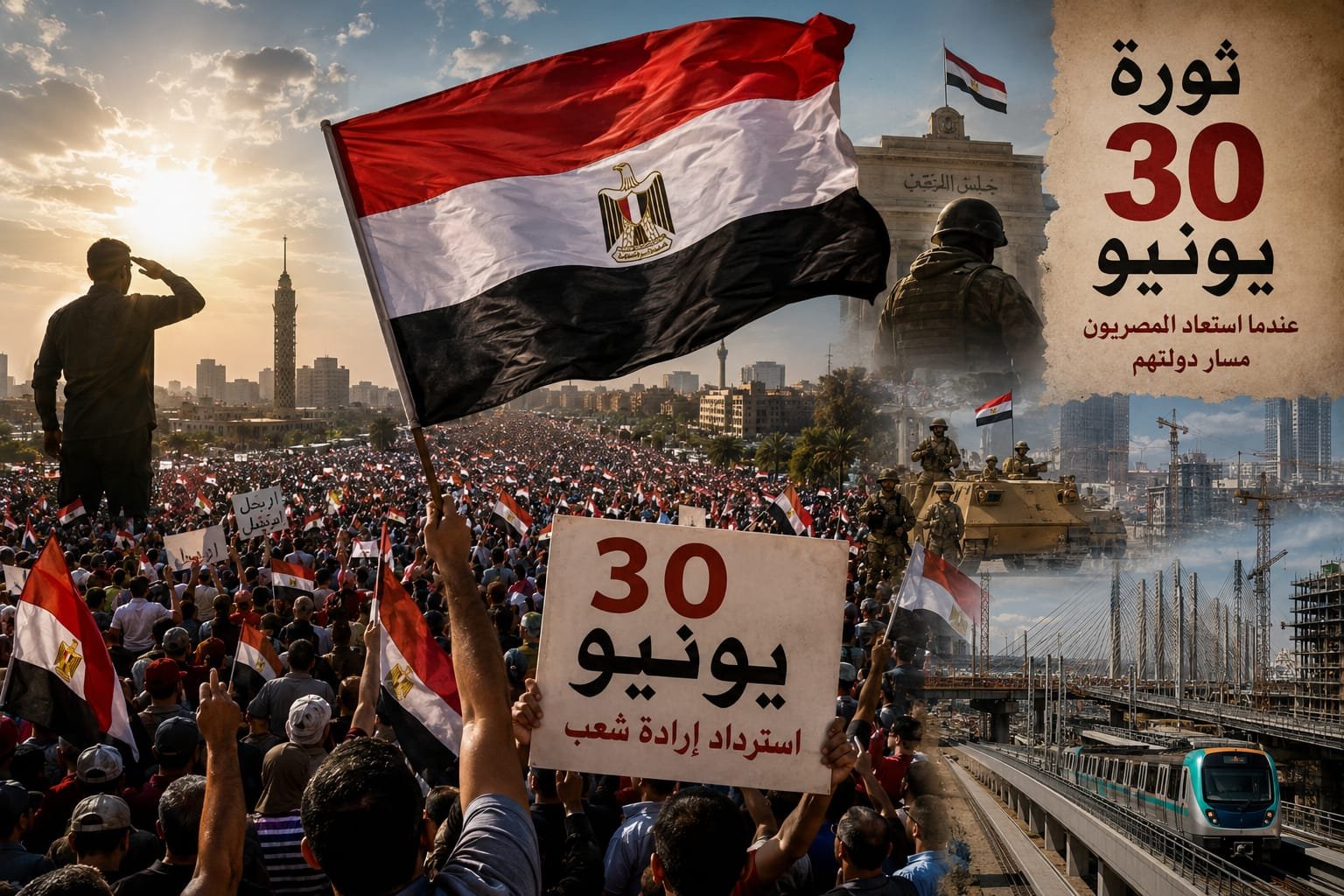
On June 30, 2013, Egypt witnessed one of the largest popular movements in its modern history, when millions of citizens took to the streets and public squares across various governorates demanding the end of the rule of the Muslim Brotherhood and the late President Mohamed Morsi, just one year after he assumed power.
Participants in those protests believed that the country was facing escalating political, economic, and security challenges that required popular intervention to correct the course and preserve the institutions of the national state.
Causes of Public Anger
The year following the Muslim Brotherhood’s rise to power witnessed a state of political controversy and societal polarization, accompanied by successive economic crises, including fuel shortages, repeated power outages, and declining investment and tourism rates.
The constitutional declaration issued in November 2012 also sparked widespread political opposition, as opposition forces at the time considered it an attempt to expand executive authority at the expense of other state institutions.
In this atmosphere, the “Tamarod” (Rebel) campaign emerged, successfully collecting millions of signatures calling for early presidential elections, becoming one of the main popular drivers that paved the way for the June 30 protests.
Millions of Egyptians in the Streets
By June 30, massive crowds had taken to the streets in Cairo, Alexandria, and other governorates, demanding the removal of President Mohamed Morsi and the holding of new elections.
The protests continued for several days until the Armed Forces announced a political roadmap on July 3, 2013, which included the temporary suspension of the constitution and the formation of a transitional administration in preparation for new elections.
Rabaa and Nahda Sit-ins
The Muslim Brotherhood and its supporters rejected the new measures and organized two main sit-ins at Rabaa Al-Adawiya and Nahda Squares, demanding the reinstatement of the ousted president.
The sit-ins continued for weeks amid local and international attempts to reach a political settlement, before security forces dispersed them on August 14, 2013, after negotiations failed. This resulted in a large number of casualties and mutual accusations regarding responsibility for the violence that accompanied those events.
A Wave of Terrorism Targeting the Egyptian State
Following the events of June 30, Egypt entered a highly difficult security phase, marked by a significant rise in terrorist operations, particularly in North Sinai.
Armed forces and police units were targeted in a series of attacks against checkpoints and security installations, while bombings hit vital infrastructure, security headquarters, and places of worship.
Electricity networks, railway lines, and several government facilities were also subjected to acts of sabotage in various governorates, posing major security challenges to the state in the years that followed.
Combating Terrorism and Restoring Stability
The Egyptian state responded by launching a comprehensive counter-terrorism strategy, including extensive military and security operations, upgrading the capabilities of the armed forces and security agencies, and strengthening border and critical infrastructure protection measures.
Over time, the state succeeded in significantly reducing the capabilities of terrorist organizations, particularly after successful security operations that eliminated many extremist strongholds.
Outcomes of the Revolution
The June 30 Revolution resulted in major political and constitutional changes, most notably the adoption of a new constitution in 2014, presidential and parliamentary elections, and the launch of major national projects in infrastructure, energy, and roads.
It also represented a turning point in the course of the Egyptian state, as its supporters viewed it as a decisive moment that preserved the national identity and state institutions, and reinforced the concept of a modern civil state in the face of polarization and division.
An Enduring Memory in the Egyptian Consciousness
Years after its outbreak, the June 30 Revolution remains a pivotal event in modern Egyptian history, representing a moment of broad popular participation that reshaped the country’s political and security landscape, and established a new phase defined by stability and the confrontation of challenges.
Discover more from المنتدى الدولى للصحافة والإعلام
Subscribe to get the latest posts sent to your email.