
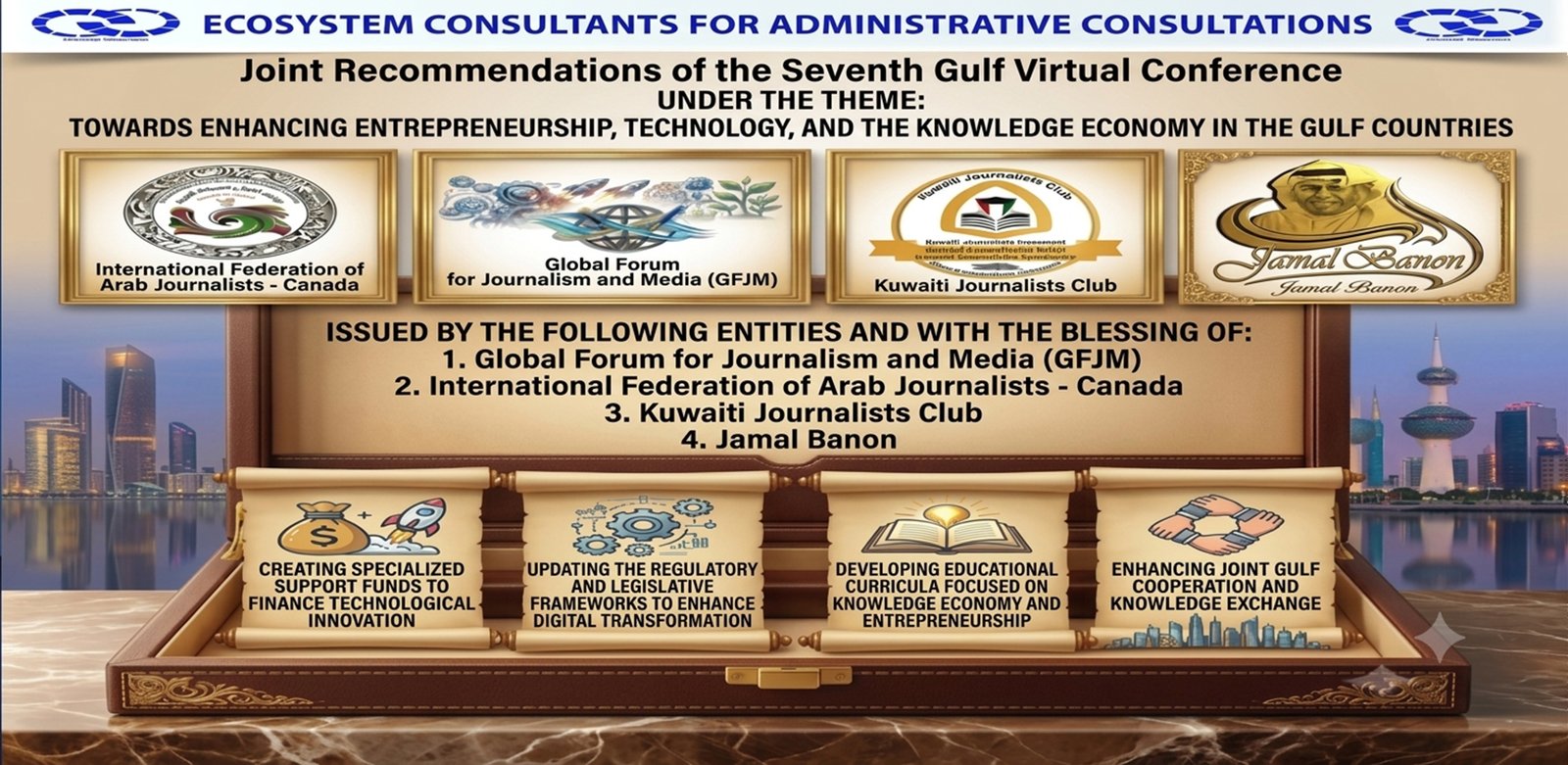
Towards Promoting Technological Entrepreneurship and the Knowledge Economy in the Gulf States: Joint Recommendations for Building a Gulf Future Based on Innovation
The Global Forum for Journalism and Media, the International Union of Arab Journalism – Canada, the Kuwait Journalists Association, and Mr. Jamal Bunnon affirmed that the coming phase requires a shared vision that goes beyond consuming technology toward producing and developing it, and that advances the building of a Gulf economy based on knowledge and innovation, promotes technological entrepreneurship, and employs artificial intelligence and the digital economy in support of sustainable development.
This came within the framework of the joint recommendations issued by the parties participating in the proceedings of the Seventh Gulf Virtual Conference, under the title “Towards Promoting Technological Entrepreneurship and the Knowledge Economy in the Gulf States”, which were the outcome of constructive dialogue and specialized perspectives addressed by the conference, including discussions on the future of technology and innovation and the role of media in supporting economic and knowledge-based development.
These recommendations stem from the importance of the role played by media, professional, and intellectual institutions in supporting the development process, and from the belief that rapid technological transformations, particularly artificial intelligence, the digital economy, and entrepreneurship, have become among the most important pillars for building the future.
The recommendations aim to support innovation and sustainable development pathways and strengthen integration among technology, education, media, and the economy, contributing to building a Gulf ecosystem capable of keeping pace with global transformations and shaping a knowledge-based future.
Gulf Universities: From Educational Institutions to Engines of Innovation
The recommendations called for transforming Gulf universities into engines of innovation and entrepreneurship by shifting their role from institutions focused on traditional education and knowledge transfer to institutions that produce innovation and create startups.
The recommendations emphasized the importance of linking scientific research funding to the ability of research to be transformed into applicable and marketable technological products and services, strengthening partnerships between universities, the private sector, investors, and innovation centers, in addition to establishing specialized innovation and entrepreneurship centers within universities to incubate ideas and transform them into economic projects.
They also called for supporting patent registration, protecting intellectual property, transforming scientific knowledge into economic value, and strengthening the role of universities as engines of economic development and builders of a knowledge-based economy.
A Unified Gulf Ecosystem to Support Technological Entrepreneurship
In the area of technological entrepreneurship, the signatories recommended studying the establishment of a joint Gulf fund to support technology startups in their early stages and provide them with the financing, guidance, and facilities necessary for their growth.
The recommendations include supporting startups in the fields of artificial intelligence, data, cybersecurity, and future technologies, providing mentoring programs that connect entrepreneurs with investors and markets, as well as facilitating the movement of entrepreneurs, talent, and licenses among the Gulf Cooperation Council countries.
They also emphasized the importance of strengthening Gulf digital economic integration and opening markets to emerging technology projects, helping them grow, expand, and reach regional and international markets.
Developing Education and Building Future Skills
The recommendations stressed that building human capacity represents the true foundation of digital transformation, calling for the restructuring and development of educational curricula in line with the requirements of the digital economy and the Fourth Industrial Revolution.
The recommendations included integrating artificial intelligence, programming, data science, cybersecurity, and robotics into different educational stages, and adopting entrepreneurial culture, artificial intelligence, and digital skills as core components of university education rather than optional fields or secondary activities.
They also called for establishing and developing innovation and artificial intelligence laboratories within educational institutions, activating practical training workshops and applied experiences to develop creativity and innovation skills, and preparing teachers and faculty members to work with modern technologies and artificial intelligence tools.
They emphasized the importance of strengthening partnerships among educational institutions, universities, and the private sector to prepare a generation capable of leading digital transformation and the knowledge economy.
Media as a Strategic Partner in the Innovation and Entrepreneurship Ecosystem
The recommendations affirmed that media has become a strategic partner in creating knowledge and supporting development, rather than merely transmitting news. They called for launching a specialized Gulf media platform for entrepreneurship and technology, a vision proposed by Dr. Hany Khater as part of his perspective on the importance of developing specialized media to support the innovation and entrepreneurship ecosystem, moving beyond traditional news coverage toward building specialized knowledge-based media.
The recommendations also called for highlighting the success stories of Gulf entrepreneurs and innovators and promoting their experiences and projects at the regional and international levels, as well as supporting specialized journalism in artificial intelligence, the digital economy, and modern technologies.
They stressed the need to train media professionals in digital journalism, data analysis, and the use of artificial intelligence tools, and to strengthen the role of media in spreading digital culture, combating misinformation, and raising awareness about the responsible use of technology.
They also called for building partnerships among media institutions, universities, and technology entities to produce knowledge-based content that serves society and the economy.
Flexible Legislation to Keep Pace with Technological Developments
On the legislative side, the participating parties recommended establishing flexible regulatory and legislative frameworks that keep pace with rapid technological developments, ensuring an environment conducive to the growth of innovation and entrepreneurship.
These frameworks include allowing startups to test their technological products and solutions within safe experimental environments (Sandbox) before obtaining final licenses, while achieving a balance between encouraging innovation and protecting society, data, and privacy.
They also emphasized the need to develop legislation related to artificial intelligence, the digital economy, and intellectual property, and to provide an attractive legal environment for investment in emerging technology projects.
An Integrated Gulf Network for Business Incubators and Accelerators
The recommendations called for building an integrated Gulf network of business incubators and accelerators and connecting them through joint digital platforms in order to establish an integrated innovation ecosystem.
This network aims to connect entrepreneurs with investors, experts, and mentors, exchange expertise and successful experiences among the Gulf states, accelerate the growth of startups and support their expansion into regional and international markets, in addition to strengthening cooperation among innovation centers, universities, and the private sector.
Integration among Technology, Media, Education, and the Economy
The recommendations affirmed that shaping the future requires an integrated ecosystem bringing together technology, education, the economy, and media, given that each sector plays a pivotal role in building the knowledge economy.
Technology represents a tool for driving transformation and development, education is the foundation for building people and future skills, the economy is the field that transforms innovation into value and development opportunities, while media represents the force that spreads knowledge and creates societal awareness.
Accordingly, the signatories recommended strengthening cooperation among these sectors to build an integrated Gulf model for the digital economy and innovation.
Data and Artificial Intelligence: Strategic Assets for the Future
Within the framework of investing in data and artificial intelligence as strategic assets, the participating parties recommended developing data infrastructure and enhancing its use in decision-making, as well as supporting data analytics and artificial intelligence projects in the public and private sectors.
They also called for encouraging innovation in artificial intelligence applications to serve the health, education, energy, industry, and services sectors, while promoting the responsible and ethical use of artificial intelligence in a manner that ensures benefiting from its potential while safeguarding the rights of individuals and society.
Moving from Consuming Technology to Producing It
The Global Forum for Journalism and Media, the International Union of Arab Journalism – Canada, the Kuwait Journalists Association, and Mr. Jamal Bunnon affirmed that the coming phase requires moving from consuming technology to producing it, and from following innovation to leading it.
The four parties stressed that building a knowledge-based Gulf economy requires investing in people, empowering entrepreneurs, developing education, strengthening scientific research, and employing media as a tool for creating awareness and spreading knowledge.
They also affirmed that the integration of artificial intelligence, entrepreneurship, education, media, and the economy represents the fundamental pillar for building a more competitive and sustainable future and consolidating the position of the Gulf states as regional and global centers for innovation and the digital economy.
A Shared Vision for Promoting Innovation and the Knowledge Economy
At the conclusion of the recommendations, the participating and signing parties, represented by the Global Forum for Journalism and Media, the International Union of Arab Journalism – Canada, the Kuwait Journalists Association, and Mr. Jamal Bunnon, affirmed that these recommendations represent a shared vision aimed at promoting a culture of innovation, supporting entrepreneurs, developing education, and empowering specialized media, contributing to building a knowledge-based society and a sustainable digital economy founded on partnership among media, academic, economic, and technological institutions.
The signatories also affirmed their commitment to supporting initiatives that strengthen cooperation among various sectors and contributing to spreading the culture of innovation and the knowledge economy throughout the Gulf and Arab region, supporting the development process and enhancing the ability of the countries of the region to keep pace with global transformations and shape a more innovative and sustainable future.
These recommendations serve as a practical framework for cooperation among media, professional, academic, economic, and technological institutions, based on a shared conviction that building a globally competitive Gulf knowledge economy begins with people, progresses through education, scientific research, innovation, and entrepreneurship, and benefits from media, technology, and artificial intelligence to create opportunities and transform knowledge into sustainable economic and developmental value.
The Parties Signing the Recommendations
Dr. Hany Khater
President of the Global Forum for Journalism and Media
President of the International Union of Arab Journalism – Canada
Dr. Zuhair Al-Abbad
President of the Kuwait Journalists Association
Mr. Jamal Bunnon
Executive Director of SMC – Media Consulting and Studies