
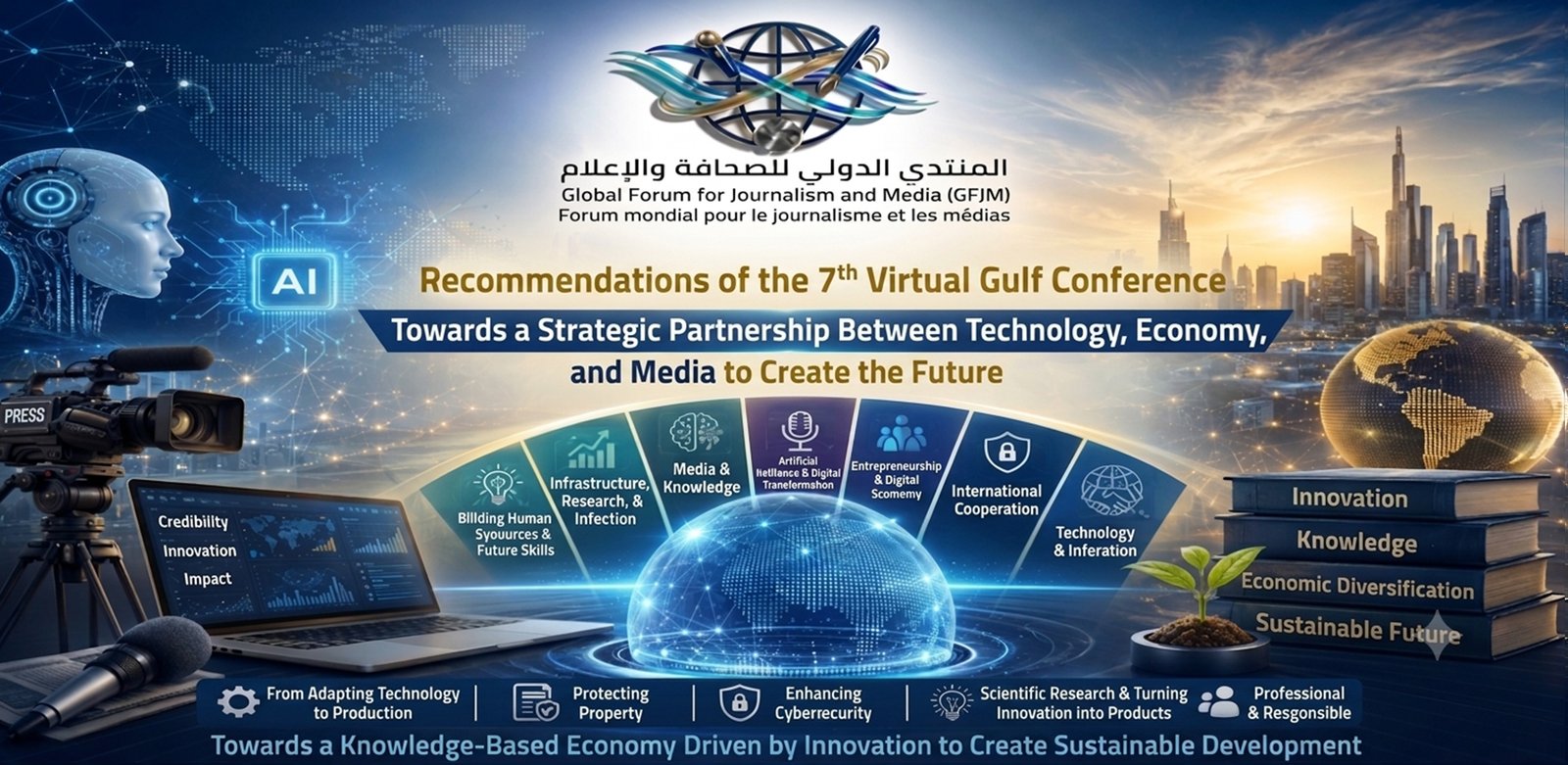
The recommendations call for preparing specialized cadres, enhancing research and development, protecting intellectual property, and supporting cybersecurity and technological sovereignty
The Global Forum for Journalism and Media announced the final recommendations of the Seventh Gulf Virtual Conference, “Techno Innovation, Techno Entrepreneurship, Techno Artificial Intelligence towards Economic Diversification,” which was held under the title “Towards a Strategic Partnership between Technology, Economy and Media for Shaping the Future,” emphasizing that the accelerating technological transformations require moving from merely using technology to producing and developing it, and building national and Gulf cadres capable of shaping the future.
The Forum explained that the recommendations stemmed from the importance of innovation, artificial intelligence and entrepreneurship in building a knowledge-based economy, and from the recognition of the pivotal role played by journalism and media in transferring knowledge, shaping societal awareness and supporting development paths.
From Consuming Technology to Producing It
The Forum emphasized that among the most prominent recommendations is moving from consuming technology to producing and developing it, through building national and Gulf capabilities in technology production, not being satisfied with using imported technologies, while supporting scientific research and innovation, localizing technical knowledge, and encouraging the development of local technological solutions and products capable of competing regionally and internationally.
The Forum pointed out that achieving sustainable economic diversification requires building integrated innovation ecosystems that bring together governments, the private sector, universities, research centers and media institutions, in a manner that enables the production of knowledge and its transformation into economic and societal value.
It also recommended increasing investment in future technology industries, foremost among them artificial intelligence, data analysis, cybersecurity, the Internet of Things and cloud computing.
Supporting Entrepreneurship and the Digital Economy
The Forum stressed the importance of promoting a culture of technological entrepreneurship among young people and transforming innovative ideas into startups capable of competing locally and internationally.
It also called for developing a supportive financing ecosystem for innovative projects, supporting venture capital funds, business incubators and project accelerators, in addition to enabling small and medium-sized enterprises to adopt modern technological solutions, improve production efficiency and enhance their competitiveness.
Artificial Intelligence and Data
The Forum affirmed the need to accelerate the use of artificial intelligence in vital sectors, including education, health, energy, industry, administration and public services, while establishing regulatory and ethical frameworks that ensure the responsible use of technology and protect data and privacy.
It also recommended considering data a new strategic wealth, and developing advanced systems for managing and analyzing it and benefiting from it in decision-making, supporting innovation and developing future solutions.
Media as a Strategic Partner in Development and Innovation
The Forum gave journalism and media a special importance within its recommendations, affirming that media is no longer merely a tool for conveying news, but has become an essential partner in building economic and technological awareness and introducing societies to the opportunities of digital transformation.
The Forum called for developing specialized media in technology and the digital economy, and empowering journalists and media professionals with the tools of the digital age through training in artificial intelligence, data analysis, digital journalism and information verification.
It also affirmed the importance of strengthening the role of media in supporting entrepreneurs and innovators, highlighting success stories and startups, combating digital misinformation, developing tools for verifying news and digital content, in addition to strengthening partnerships between media institutions and technological and research entities.
Investing in People and Preparing Technology-Producing Cadres
In the area of human development and future skills, the Forum affirmed that investing in people represents the true foundation of digital transformation, calling for developing education and continuous training and building generations that possess technology, innovation and creativity skills.
The Forum particularly stressed the need to prepare specialized national and Gulf cadres in producing and developing technology, rather than merely using ready-made technologies, with a focus on artificial intelligence, programming, robotics, data analysis, cybersecurity and advanced digital technologies.
It also recommended enhancing research and development, linking it to the needs of the economy and labor market, attracting global talents and expertise and localizing knowledge, establishing specialized educational pathways in future technologies, and supporting youth talents and innovations.
The Forum also affirmed the importance of building partnerships between educational institutions, the private sector and technology companies, and developing programs for reskilling to keep pace with technological transformation.
Infrastructure and Technological Sovereignty
The Forum called for developing advanced digital infrastructure that includes data centers, cloud computing, telecommunications networks and modern technologies, in a manner that enhances the capacity to produce and develop technology and supports technological independence and sovereignty.
It also recommended developing advanced national and Gulf cybersecurity systems, qualifying specialized cadres, and enhancing the protection of data, systems and critical infrastructure from digital risks and threats.
The recommendations also included protecting patents and intellectual property, and encouraging researchers and innovators to register their innovations and transform knowledge and innovations into products, services and companies capable of competing.
The Forum also stressed the need to link scientific research to the market, and enhance cooperation among universities, research centers, the private sector and investors, in a manner that ensures the transformation of research results and innovations into prototypes, products, companies and economic projects capable of scaling and competing locally and internationally.
Enhancing Gulf and International Cooperation
Within the framework of enhancing cooperation, the Forum recommended establishing a Gulf network for technology, media and innovation as a platform for exchanging expertise among governmental, economic, academic and media institutions, and enhancing cooperation in building the knowledge economy.
It also called for strengthening the global media presence of the Gulf, and benefiting from digital media and modern multilingual platforms to introduce Gulf achievements and innovative projects, attract investments and build international partnerships.
The Forum: Technology, Economy and Media Are Partners in Shaping the Future
The Global Forum for Journalism and Media affirmed in its final statement that building the future requires genuine integration among technology, economy and media; technology creates transformation, the economy turns innovation into value, and media transfers knowledge and shapes societal awareness.
The Forum also affirmed that one of its main objectives is to contribute to conveying a true and balanced image of the Arab world to the world, and correcting the stereotypes that may be conveyed about Arab societies, through Arab media that is more open to the international community and capable of communicating Arab achievements, capabilities and opportunities to the global audience.
The Forum pointed out that achieving this vision requires Arab media that goes beyond addressing the Arab audience to opening up to the world, thereby enhancing the Arab presence in the international media scene and enabling the presentation of a more accurate and objective image of the Arab reality.
The Forum concluded by affirming that these recommendations represent an integrated vision based on producing and developing technology, investing in people, supporting research and innovation, transforming knowledge into economic value, and strengthening the role of media as a strategic partner in building the knowledge economy, contributing to building a more innovative and sustainable future and enhancing Gulf and Arab cooperation and openness to the world.
Dr. Hany Khater
President of the Global Forum for Journalism and Media