
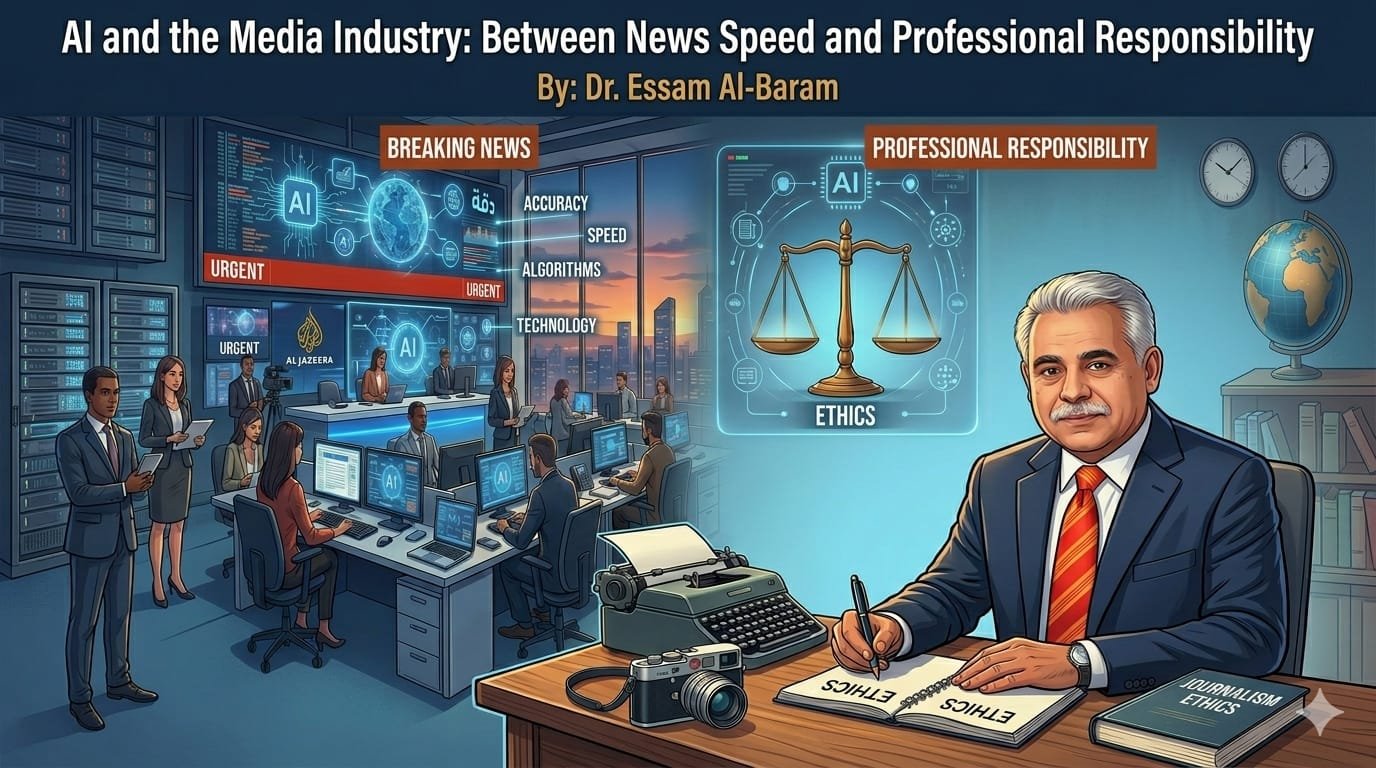
 Dr. Essam Al-Barram
Today, the world is witnessing rapid transformations across various sectors as a result of tremendous technological development, and the media sector is among the fields most directly affected by this digital revolution. With the emergence and widespread adoption of artificial intelligence technologies in media institutions around the world, a pressing question arises: How can the media benefit from these modern technologies without losing its professional essence and the journalistic mission based on accuracy, credibility, and responsibility?
Artificial intelligence has changed the way news is produced, published, and consumed. After news preparation once required long hours of research, verification, and editing, some intelligent systems are now capable of gathering information, analyzing it, and producing initial reports within just a few minutes. This development has given media institutions greater ability to keep pace with rapidly unfolding events and meet the needs of audiences who increasingly seek instant information anytime and from anywhere.
Artificial intelligence has also contributed to improving the audience experience by providing personalized content that aligns with users’ interests and digital behaviors. Recommendation algorithms used by news websites and social media platforms have become capable of suggesting news and topics that match each user’s interests, thereby increasing rates of engagement, reading, and viewing. On the other hand, intelligent analytics tools have helped media institutions better understand audience trends, enabling them to develop their editorial and marketing strategies more effectively.
However, these significant advantages are not without real challenges that impose themselves on the media landscape. The ease of content production and the speed of publication may sometimes lead to the spread of inaccurate information or misleading news if they are not subject to professional review and verification. Furthermore, excessive reliance on automated systems may weaken the role of journalists as essential contributors to gathering information, analyzing it, and presenting it within the correct context.
Another issue emerges in the form of deepfake technology, which relies on artificial intelligence to produce images, videos, or audio recordings that appear authentic despite being entirely fabricated. This technology has become a growing source of concern for both media institutions and the public because it can be used to spread rumors, influence public opinion, or damage the reputation of individuals and organizations. Therefore, there is an urgent need to develop advanced verification tools and enhance media literacy among audiences so they can distinguish between genuine and fake content.
Amid these transformations, the human element remains the cornerstone of the media process. Artificial intelligence, regardless of its capabilities, does not possess human sensitivity or the ability to understand the social, cultural, and ethical dimensions of events in the way a professional journalist can. The journalist’s mission is not limited to conveying information; it also includes interpreting facts, analyzing them, connecting them to different contexts, and adhering to the professional standards that govern media work.
Hence, the importance of retraining media professionals and equipping them with the digital skills necessary to deal with modern technologies becomes evident. A successful media professional in the digital age is one who can employ artificial intelligence tools to serve their work without allowing them to dominate professional decisions. Media institutions are also required to establish clear policies for the use of these technologies in a manner that ensures transparency and preserves public trust.
The future of media will not be based on competition between humans and machines but rather on integration between them. Artificial intelligence can handle routine and repetitive tasks, saving time and effort, while journalists focus on investigation, analysis, creativity, and producing value-added content. This integrated model may contribute to the development of media and strengthen its ability to fulfill its social role within an information environment that is becoming increasingly complex day by day.
The impact of artificial intelligence is not limited to major media institutions; it has also extended to independent journalists and digital content creators who have found in these technologies effective tools that help improve the quality of their work and increase productivity. It is now possible to benefit from artificial intelligence applications in transcribing audio interviews, translating texts, analyzing large datasets, suggesting news headlines, and even assisting in the preparation of visual and audio content. This has contributed to reducing operational costs and opening new opportunities for small and medium-sized institutions to compete in a rapidly changing media market.
At the same time, these transformations place significant responsibility on academic institutions and media training centers, which are now required to update their curricula and educational programs to align with the demands of the digital age. Preparing media professionals capable of understanding modern technology and using it efficiently is no longer an optional choice but has become a professional necessity to ensure the continuity and development of the media sector. It is important for these programs to combine technical skills with ethical and professional standards so that media professionals can use intelligent tools responsibly in service of truth and the public interest.
Legislation and laws related to digital media also require continuous review to keep pace with rapid developments in the field of artificial intelligence. Issues related to intellectual property rights, personal data protection, and the accountability of entities producing automated content represent growing legal challenges that require cooperation among governments, media institutions, and technology companies. Such cooperation is viewed as an essential factor in building a safer and more reliable media environment that ensures the benefits of technological innovation without compromising individual rights or threatening societal stability.
Therefore, it can be said that artificial intelligence represents a major opportunity for the media if used properly, while also constituting a real challenge if professional and ethical safeguards are absent. Between the speed of news enabled by technology and the responsibility of the profession imposed by journalistic values, balance remains the decisive factor in building a modern media capable of keeping pace with the future without sacrificing its fundamental principles. The success of media institutions in this path will determine the shape of journalism in the coming decades and will directly influence the quality of information reaching societies and the media’s ability to fulfill its enlightening, oversight, and developmental mission.
Discover more from المنتدى الدولى للصحافة والإعلام
Subscribe to get the latest posts sent to your email.