
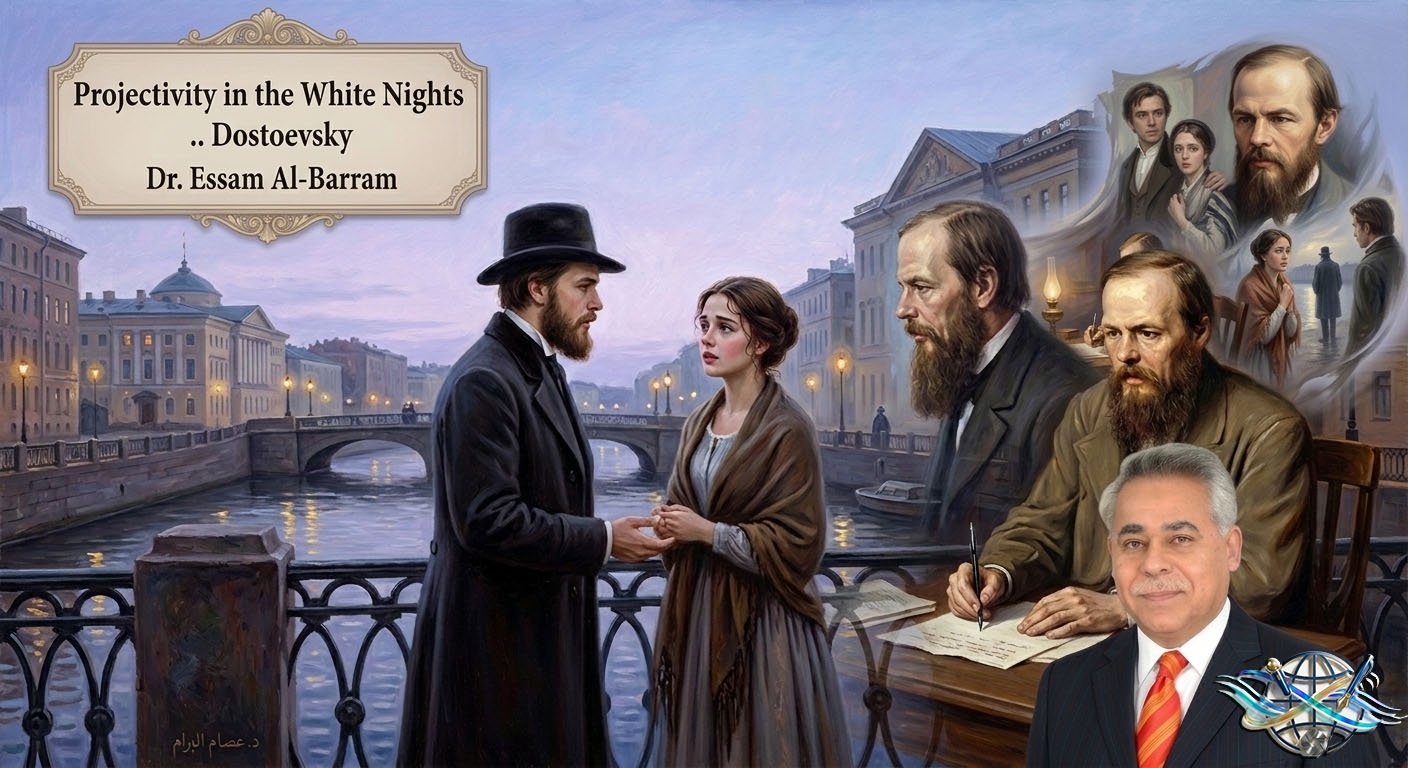
 Dr. Essam Al-Barram
The personality of the novelist Fyodor Dostoevsky constituted a turning point in the history of the world novel; a personality that blended literary genius and writing with the employment of the complex human psyche, in all its intricacies.
The novel White Nights is one of the early works of the great Russian writer Dostoevsky, which he published in his youth at the turn of the nineteenth and the beginning of the twentieth century, and which has recently been issued by the Arab Cultural Center, translated by the distinguished Sami Al-Droubi.
There is no doubt that the classics of world novels were a starting point for many creators who were schooled in them. These novels varied in propositions that blended imagination with reality, and it is worthwhile to revisit these readings with parallel perspectives at times and intersecting ones at others. While the modern novel may have been monopolized by modern schools, from narratology to others, the world of the classical novel, theater, and all creative arts still pulses with strength in the spirit of creativity and in the souls of those who seek to write a creative text. They draw from the abundance of global human literary production and the inherited legacy of ancient Arab heritage to comprehend the course of events within the text through a contemporary philosophy.
His style, distinguished by a captivating flow in observing the human world—monitoring behavior and psychological reactions, and what stirs within its depths, conveyed to us through the characters of his heroes—along with how the chain of conflict and the theme of the text develop, reflects a capacity rarely found except among a few novelists. We find multiple levels addressed: at times divided between religion and existentialism, at times human values and ethics, or the struggle between good and evil within the human soul. It is thus multifaceted in faces, structures, and voices.
Many critics have differed in classifying the protagonist’s character in this novel, which has been distributed between the Romantic school and the fantasy of the novelistic genre, especially when compared across various critical schools and their philosophies.
The novel, through its four nights, and the protagonist—whose character is derived from that of the writer himself—gives the reader the sense that it is a projection that the narrator conceals and casts onto the hero of his events. Living in the city of St. Petersburg, this is a character who lives alone, converses with himself, with no relationships or friendships; no one shares his joy except the sorrow that inhabits his scattered self within a world that surrounds him from all corners of the city. The novelist deliberately, with high technique, refrains from giving the protagonist a name, intending instead to instill in the reader a sense of pursuit and curiosity to delve into and discover this character who lives within the corridors of the text.
This protagonist is a dreamy, overflowing yet silent character, boiling internally with intense emotions toward Nastenka, that young woman who was involved in an emotional relationship with a lodger to whom her grandmother had rented a room, then he left her, traveling to another city with the hope of returning to her—Nastenka—whom he had promised to meet later. At the same time, the protagonist meets Nastenka, grateful to fate that made him rescue her by chance on a public road from a reckless man who almost assaulted her.
Here, the writer says through his protagonist, “I am shy,” as he speaks to Nastenka after assisting her from the reckless man in the street. She asks him, “Why is your hand trembling?” He replies, “I am shy with women; I am nervous, I do not deny it. I have never imagined speaking with a woman. Yes, my hand was trembling. I am alone and do not know how to speak to them.”
Here, the Russian scholar Ivan Pavlov, founder of the school of conditioning in psychology, sees that the personality of a character like Dostoevsky’s protagonist in White Nights, whose state of imbalance is imposed by conflicting inner impulses, is driven to attempt to break free from them; yet the coercive self within him stands as a barrier between him and the conditioned reality imposed upon him.
If the first night of the novel is the station in which the protagonist questions himself, repeating to himself unclear words, sharing the road as he moves, leaping with his gaze between the old man who greets him daily as he passes through the garden and the balconies of buildings along the streets—unaware of where his steps are leading him in this turbulent world—until he meets Nastenka by chance, then the text enters the second night and the dialectic of psychological conflict when he learns of Nastenka’s relationship with the lodger in her grandmother’s room, who once promised to return to her after his long journey.
If the second night of the novel is immersed in description and emotional, mental elaboration of events, imbued with a sentimental tone reflecting the spirit of the protagonist or the writer’s personality, it suggests to the recipient that creativity associated with a period in a person’s early youth is not the same as when writing in later stages. This is evident in the complex and layered emotional development of Dostoevsky when he later wrote his novel Crime and Punishment, and what that novel carried in its depiction of the depth of human impulses and the maturity of his creative experience compared to what he wrote in White Nights.
Human creativity is an open horizon without end; it consumes and exhausts time and strenuous effort from the creator. Thus, one finds the image of the narrator (for example, but not limited to) in the third night of the novel, when Nastenka begins to speak about her experience, while the narrator becomes immersed, at times in his suppressed emotional reaction, and at other times in his confusion among the elements of her speech and her relationship with the young lodger whom she had long awaited.
Dostoevsky may conceal the state of joy within himself, and one may find that what dictates his refinement in employing emotion in the creative text allows him to address human emotional states while he himself experiences an emotional condition stirring within him, which he seeks to project onto the protagonist of the novel. To ascend into the depths of awareness, emotion, and their reactions may be found within poetic texts; however, when the narrator seeks to project his subjectivity through an artistic method, he must have mastered his artistic, technical, and narrative tools. Employing imagination within the theme of the text is a special condition; it is not easy for the creator to present it as a complete work that convinces the recipient or establishes itself as a human work that struggles at times between the writer and, at other times, the addressed human recipient.
If the fourth and final night of the novel is where Dostoevsky seeks to conclude his hypothetical and projective world through the voice of his protagonist (the narrator), he draws closer and closer to the human world with its anxious emotions and the fragmentation of his emotional state toward Nastenka. As the moment of confession between them approaches, he finally declares his love for her. Suddenly, in a moment like a flash, the lodger appears from afar, and Nastenka’s gaze intersects between the one she loved on the first night and the one whose love for her has erupted on the fourth night.
Discover more from المنتدى الدولى للصحافة والإعلام
Subscribe to get the latest posts sent to your email.