
 By Prof. Dr. Omar Ali Al-Harash
Syria is currently going through a very sensitive and critical transitional phase in its contemporary history, following the fall of Bashar Al-Assad’s regime at the end of 2024. The country is currently led by a transitional government headed by Ahmad Al-Sharaa, which is striving to rebuild state institutions, integrate armed factions, and achieve national reconciliation amid enormous security and economic challenges.
The following is a detailed overview of the current situation regarding the recent terrorist operations, those supporting them, and those benefiting from them:
1. What Is Happening in Syria Now? (The Security and Political Situation)
Despite the existence of signs of progress, such as the lifting of some international sanctions (such as the American Caesar Act) and the decline in the intensity of large-scale battles, the situation remains extremely fragile and is witnessing the following:
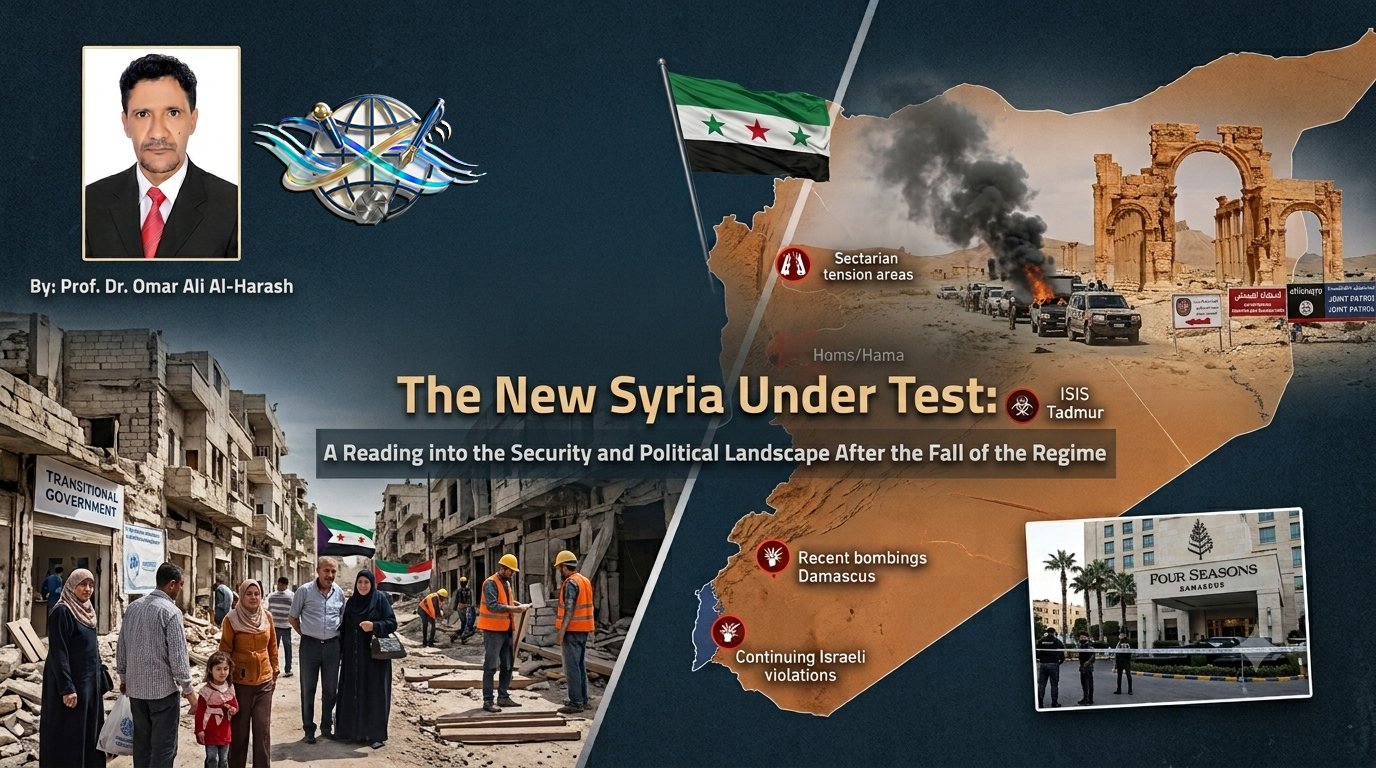
Recent bombings in Damascus: The capital, Damascus, has recently witnessed bombings using explosive devices (including an explosion near the Ministry of Justice and the Four Seasons Hotel), which coincided with the historic visit of French President Emmanuel Macron to Damascus. The Syrian authorities officially announced the arrest of a sabotage cell responsible for these bombings.
Activity of extremist organizations: The organization “ISIS” and its sleeper cells continue to represent a major security threat, as the organization has claimed responsibility for, or has been attributed with, attacks targeting military patrols (such as the recent attack near Palmyra that targeted a joint American-Syrian patrol).
Sectarian and regional tensions: There are incidents of violence, sectarian attacks, and acts of retaliation in some provinces such as Homs and Hama, in addition to ongoing tensions in the north and east between the Syrian Army and the Syrian Democratic Forces (SDF).
Israeli violations: Syria faces challenges to its sovereignty in the south due to ongoing Israeli incursions, strikes, and violations of ceasefire lines.
2. Who Supports the Recent Terrorist Operations?
According to the preliminary investigations announced by the Syrian Ministry of Interior and international reports, the parties behind these operations are divided into:
ISIS and extremist cells: Security officials in Damascus indicated that the cell that carried out the recent Damascus bombings is linked to ISIS. This organization relies on a local and transnational extremist ideology and exploits smuggling networks, self-financing or secret online funding, and isolated desert areas to finance its operations.
Parties seeking to undermine stability (indirect supporters): Historically, regional and international intelligence agendas have overlapped in the Syrian scene. Syrian investigations continue to search for external links to these cells, as observers believe that there are regional powers or extremist factions whose interests were harmed by the fall of the previous regime and the rise of a moderate transitional authority seeking openness toward the international community and comprehensive reconciliation.
3. Who Benefits from These Terrorist Operations?
Those who currently benefit from destabilizing Syria are the parties that see the success of the transitional phase as a threat to their existence or their agendas:
ISIS and extremist organizations: The primary beneficiary, because chaos and the absence of security are the only fertile environment that allows these organizations to regroup, expand, and impose their control again, exploiting any security gaps or sectarian disputes.
Forces rejecting Syrian-international openness: The bombings that coincided with French President Macron’s visit were clearly aimed at sending a message to the international community that “Syria is unsafe,” in order to disrupt the transitional government’s efforts to break international isolation, restore diplomatic relations, and attract investments for reconstruction. Therefore, those harmed by the international legitimization of the new authority are indirect beneficiaries of these attacks.
War profiteers and organized criminal networks: The absence of a strong central rule of law serves the interests of smuggling networks, kidnapping-for-ransom operations, and those who illegally seize real estate and land, whose activities thrive in an atmosphere of fear and security instability.
Discover more from المنتدى الدولى للصحافة والإعلام
Subscribe to get the latest posts sent to your email.