
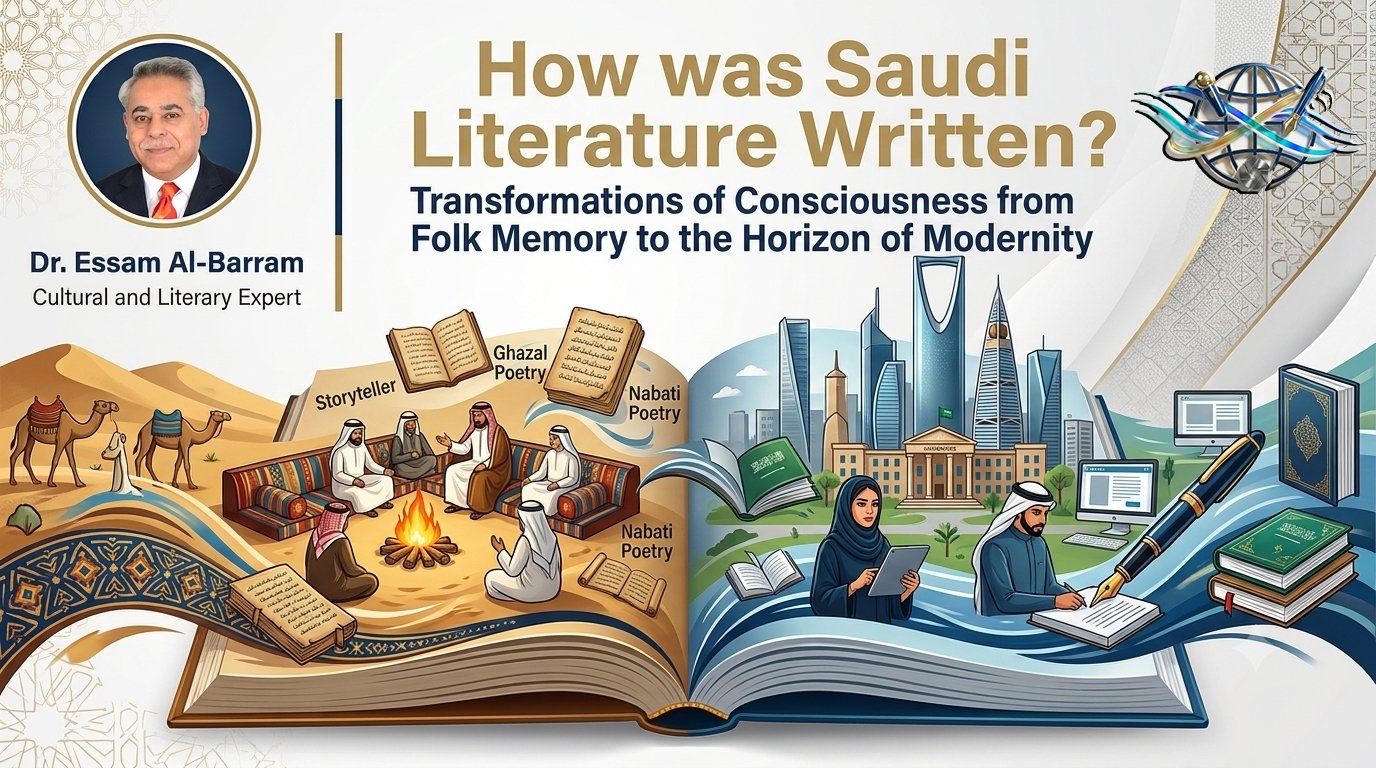
 Dr. Essam Al-Barram
In the course of the formation of Saudi national consciousness, literature occupies a central position as a mirror of the profound transformations that society has witnessed from the period before unification until the present, which is rich with cultural and intellectual projects. What is remarkable is that this path did not begin from nothing; rather, it emerged from a rich popular narrative that was formed over centuries in gatherings, markets, homes, and the desert communities, where storytelling was a means of preservation, expression, and the construction of collective meaning. From this folkloric reservoir, modern literary writing emerged to reformulate the major questions concerning identity, belonging, modernity, the state, and humanity within a transforming national context.
The popular narrative in the Arabian Peninsula was not merely a collection of stories for entertainment; it was a vessel of collective memory carrying values, customs, models of heroism, chivalry, and the relationship with land, tribe, and religion. Oral stories, popular biographies, proverbs, and Nabati poetry formed the daily language of the people and expressed their worldview and their mechanisms of adaptation to a harsh and changing environment. This narrative contributed to establishing an early sense of spatial and spiritual belonging, a feeling that would later find its extension in written literature with the emergence of the modern Saudi state and the rise of the concept of the unified homeland.
The Beginning and the Historical Transformation
With the unification of the Kingdom of Saudi Arabia, a new phase began in social and cultural history, which was clearly reflected in literature. Society moved from scattered traditional structures into a unified political entity with a clear religious and civilizational project. This transformation produced new questions regarding the relationship between the individual and the collective, authority and knowledge, and authenticity and renewal. During this early stage, reformist and renaissance literature emerged, influenced by the broader Arab and Islamic thought while remaining rooted in the local reality. It emphasized the value of stability and unity and highlighted the importance of knowledge and building the human being.
During the 1950s and 1960s, literary awareness began to take more mature forms with the spread of formal education, the emergence of journalism, the expansion of cities, and the discovery of oil, along with the profound economic and social transformations that followed. At this point, Saudi writers began writing about the shock of modernity, the differences between rural and urban life, and the transformations in family structures and social relations. The short story was the most prominent form during this period because it was closest to capturing the moment and expressing anxiety and open questions. Nevertheless, the presence of values remained clear, as social criticism was not separated from the concern for social cohesion and respect for its principles.
The modern Saudi novel represents the culmination of this transformational path, as it has been able to absorb the popular narrative and re-employ it within contemporary artistic structures. Many novels have drawn inspiration from oral storytelling in their temporal construction, in the multiplicity of voices, and in the presence of the knowledgeable or wise narrator. They have also restored the place as a narrative protagonist, as the village, the city, the desert, and the sea are not merely backgrounds, but rather symbolic spaces carrying the history of transformation from simplicity to complexity and from isolation to openness. This intelligent use of folklore has given the Saudi novel its uniqueness and made it capable of addressing both the local and Arab reader in a language that combines authenticity and modernity.
One of the most prominent features of Saudi literature in expressing national transformations is its ability to observe political and social change without falling into directness or slogans. The state, as an organizing framework for life, appeared in literary texts through its impact on education, work, women, and urban development, rather than through direct political discourse. Writers wrote about school, university, employment, travel, and the new city as lived experiences that reshape the individual’s awareness of himself and his homeland. In this context, the positive aspects of the Saudi experience are reflected, as political stability appears as a condition for cultural development, and development is embodied in the details of daily life.
Cultural Transformations
Cultural transformations have also been a central theme in modern Saudi literature. With openness to the world, the flow of media, and changing patterns of consumption, questions of identity, language, and values emerged. Literature did not adopt a position of rejection or blind fascination; rather, it sought to balance between belonging and openness. Many texts emphasize that Saudi cultural identity is not an obstacle to modernity, but rather a source of strength that gives modernity a human and ethical meaning. This balanced awareness reflects cultural maturity that aligns with the Kingdom’s vision of building a vibrant society proud of its roots and open to the future.
The role of women in Saudi literature represents one of the prominent indicators of the transformation of national consciousness. From a marginal or symbolic presence in popular narratives to an active voice in modern novels and short stories, women writers and female literary characters have come to express a changing social experience within a national framework that supports their empowerment. Literary texts have documented transformations in women’s education, work, and social participation as part of a comprehensive national project, rather than as a conflict with society. This positive approach reflects a dynamic reality confirmed by contemporary cultural and social policies in the Kingdom.
The role played by Saudi cultural institutions in supporting literature and encouraging creativity cannot be overlooked. Literary clubs, cultural magazines, awards, and forums have provided spaces for discussion and publication and have contributed to building a diverse literary scene. This institutional support reflects an official belief that culture is one of the pillars of development and that literature is a partner in shaping national consciousness. Therefore, the flourishing of the Saudi novel in recent decades is not an individual phenomenon, but rather the result of cultural accumulation supported by a clear vision.
In the current context, and amid the major transformations taking place in the Kingdom within an ambitious vision for the future, Saudi literature continues its role in keeping pace with change and anticipating its horizons. New writing is bolder in form and deeper in its questions, yet at the same time it is more reconciled with the national identity. There is an awareness that transformation is not a break with the past, but rather an extension of it, and that popular narrative, with all the wisdom and imagination it carries, can be a source of modern creativity. This integrated perspective reflects the maturity of national consciousness and its ability to embrace diversity and change.
It can be said that Saudi literature, in its transition from popular storytelling to the modern novel, has embodied the path of national consciousness through its various transformations. It has preserved its folkloric and value-based roots while at the same time opening up to the techniques and questions of the era. It has expressed political, social, and cultural transformations in a balanced human language that highlighted the positive aspects of the Saudi experience in stability, development, and human-building. Through this literature, the Kingdom appears not merely as a geographical space, but as a renewed civilizational experience that writes itself story after story, and vision after vision.
If we delve deeper into the relationship between Saudi literature and national consciousness, we can observe that the transformation was not only in themes or artistic forms, but also in the writer’s own view of his role and function within society. The Saudi writer is no longer merely a narrator of stories or a witness to transformations; rather, he has become a partner in formulating the major questions related to the future, knowledge, and humanity. This transformation in the awareness of the writer’s role reflects, in turn, a broader transformation in national consciousness, which has come to view culture as a soft power that contributes to strengthening the Kingdom’s civilizational position and consolidating its image as a state with cultural and human depth.
The Homeland and the Modern Concept of Literature
Modern Saudi literature has contributed to redefining the concept of the homeland from being merely a space of protection and stability into a space of achievement and ambition. New fictional and narrative texts are filled with images of work, ambition, travel, and return, as well as questions related to success, failure, and self-realization within a supportive national framework. The homeland in these works is not a burden or an oppressive authority, but rather a space that embraces human experience with all its contradictions. This positive perception reflects what the Kingdom has achieved in balancing the preservation of principles with opening broad horizons for individuals to participate in development and in shaping the future.
The place in Saudi literature has also witnessed an important semantic transformation. Saudi cities, which appeared in old narratives as stations or limited spaces, have become in modern novels vibrant cities full of life and cultural and architectural diversity. Riyadh, Jeddah, Dammam, Abha, and others have transformed into symbols of profound social, economic, and cultural transformations. This intensive presence of the city reflects the success of the Kingdom’s development experience and its ability to build urban spaces that combine authenticity and modernity, which writers have captured with aesthetic sensitivity and balanced critical awareness.
The presence of the desert and the natural environment is no less important in this context, as Saudi literature has maintained an emotional relationship with the original place. The desert is no longer only a symbol of hardship and isolation, but has become in many texts a space for contemplation, serenity, and a return to roots. This aesthetic use reflects a growing environmental and cultural awareness that aligns with the Kingdom’s interest in preserving natural heritage and restoring a balanced relationship between human beings and their environment.
The Narrative Language in Its Linguistic Dimension
In its linguistic dimension as well, Saudi literature reflects a transformation in national consciousness. Modern narrative language combines standard classical Arabic with a local spirit derived from dialects, proverbs, and popular expressions without losing its beauty or depth. This combination reflects confidence in cultural identity and the ability to transform linguistic uniqueness into an aesthetic element rather than an obstacle. It confirms that national identity is not static, but rather alive, capable of renewal and interaction.
The expansion of the Saudi literary scene and the diversity of its voices reflect, at their core, a state of cultural maturity and stability. The diversity of perspectives and experiences is not viewed as a threat, but rather as a richness that enhances internal dialogue and strengthens the national fabric. Literature here performs a profound unifying function, as it allows every group to see itself represented within the larger national narrative.
In this sense, it can be said that Saudi literature today does not merely document transformations, but also participates in guiding them through building a positive awareness of national identity and the ability to change. It is a literature that reflects society’s confidence in itself and its future and translates the Kingdom’s ambition to become a civilizational model that combines deep roots with an ambitious vision. In this meeting between narrative and awareness, the value of literature is embodied as both a witness and a creator of the nation’s path.
Discover more from المنتدى الدولى للصحافة والإعلام
Subscribe to get the latest posts sent to your email.