
 By Amal Mokhtar
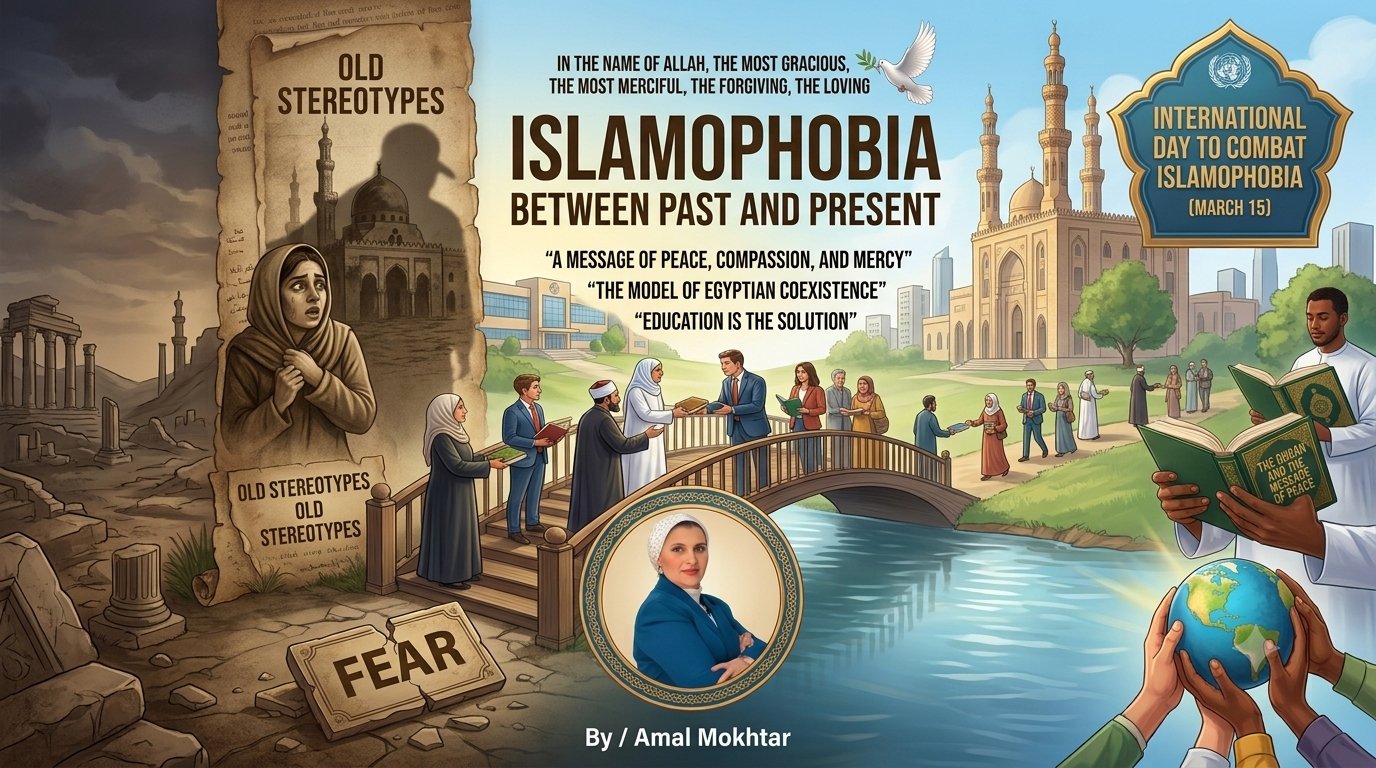
The United Nations has designated the International Day to Combat Islamophobia, observed annually on March 15, to raise awareness of this phenomenon and encourage international cooperation to address it.
However, we should not generalize by claiming that the West hates Islam while the East defends it. Rather, there are extremist right-wing groups, as well as certain secular left-wing circles, that seek to diminish the cultural and social role of Islam so that Muslims and their faith do not play a prominent role in European societies.
There is also a widespread misconception among some non-Muslims, fostered by these groups, that the God of Islam is harsh and unforgiving. This stands in contrast to the reality that God in Islam is known by many names, including The Most Compassionate, The Most Merciful, The All-Forgiving, The Most Loving, and The Most Gentle, among many others.
Former Egyptian President Anwar El-Sadat once stated during a television interview titled The Crisis and Faith with Hald Brydsen that the person who first opened his heart to the true meaning of faith during his imprisonment was Lloyd C. Douglas, a Christian minister, after he read Douglas’s book Magnificent Obsession.
Likewise, in 1946, Sheikh Mohamed Arafa, one of Egypt’s distinguished Islamic scholars, published an article in Al-Azhar Magazine calling for greater cooperation between Islam and the West. Motivated by the devastation of the Second World War and the invention of the atomic bomb and other destructive weapons, he warned that humanity faced annihilation if such weapons were used again. He concluded that there was no alternative but to bring nations closer together, eliminate the causes of conflict and hatred, and regard the entire world as one shared community. Sheikh Arafa believed that the West should seek to understand Islam, just as Muslims should understand Western civilization. Once mutual suspicion was removed, both civilizations could cooperate in serving humanity, allowing understanding to replace hostility and peace to replace conflict.
United Nations Secretary-General António Guterres also emphasized this message, stating:
“For more than 1,000 years, Islam’s message of peace, compassion, and mercy has inspired people around the world. The word ‘Islam’ itself shares the same linguistic root as the word ‘peace.’ When I served as the United Nations High Commissioner for Refugees, I witnessed the generosity of Muslim countries that opened their doors to people forced to flee their homes, while many other nations closed their borders. I also saw a contemporary reflection of the Qur’anic teaching found in Surah At-Tawbah: ‘And if any of the polytheists seeks your protection, then grant him protection so that he may hear the Word of God, and then escort him to a place of safety. That is because they are a people who do not know.’ This protection, as stated in the Qur’an, applies equally to believers and non-believers. It is a remarkable expression of refugee protection centuries before the 1951 Refugee Convention.”
The Secretary-General has also warned that discrimination and hatred against Muslims have reached alarming, even epidemic, levels following the release of an international report by the United Nations Human Rights Council documenting the rise of anti-Muslim hatred and discrimination in various parts of the world.
I also agree with Miguel Ángel Moratinos, the United Nations High Representative for the Alliance of Civilizations and the UN Special Envoy to Combat Islamophobia, who stated that Islam is not well understood in the Western world. Therefore, education must play a central role. We need dedicated educational programs that explain the true nature of Islam and the Qur’an, as many people have never read the Qur’an and therefore know little about its teachings. By promoting knowledge and correcting misunderstandings, we can lay the foundations for stronger and healthier relations. We must strengthen mutual respect and incorporate stronger legal protections within Western and European legal systems to combat discrimination, hatred, and violence against Muslims who simply wish to live in peace and dignity.
Several priorities should guide efforts to combat this form of racism. These include promoting interfaith dialogue to strengthen mutual understanding and build bridges of trust, expanding international cooperation among governments and international organizations to exchange expertise and implement initiatives aimed at combating religious intolerance and hatred, and encouraging moderate religious discourse that promotes peace and respect for others.
Equally important is responsible media that confronts misinformation, highlights positive examples, and presents the true message of Islam to audiences around the world.
Finally, I invite the world to look at the Egyptian experience. Throughout its long history, Egypt has served as a model of coexistence among followers of different religions. Muslims, Christians, and Jews have lived together as part of one national fabric, united by their shared belonging to their homeland. Religious identity has never been the defining measure of citizenship in Egypt. Instead, the principles of tolerance and peaceful coexistence have formed the foundation of the relationships among the people of the nation.
Discover more from المنتدى الدولى للصحافة والإعلام
Subscribe to get the latest posts sent to your email.