
 Haidy Mostafa Makki
Between Justice and Interests… Does World Football Need Greater Transparency?
Football in the twenty-first century is no longer merely a game based on skill, fitness, and tactical planning. It has become a vast global system in which sport intersects with economics, media, politics, and international relations. With this major transformation, decisions made on the pitch have acquired an impact that extends far beyond ninety minutes, as they can determine the fate of national teams, influence investments, and alter the course of entire tournaments.
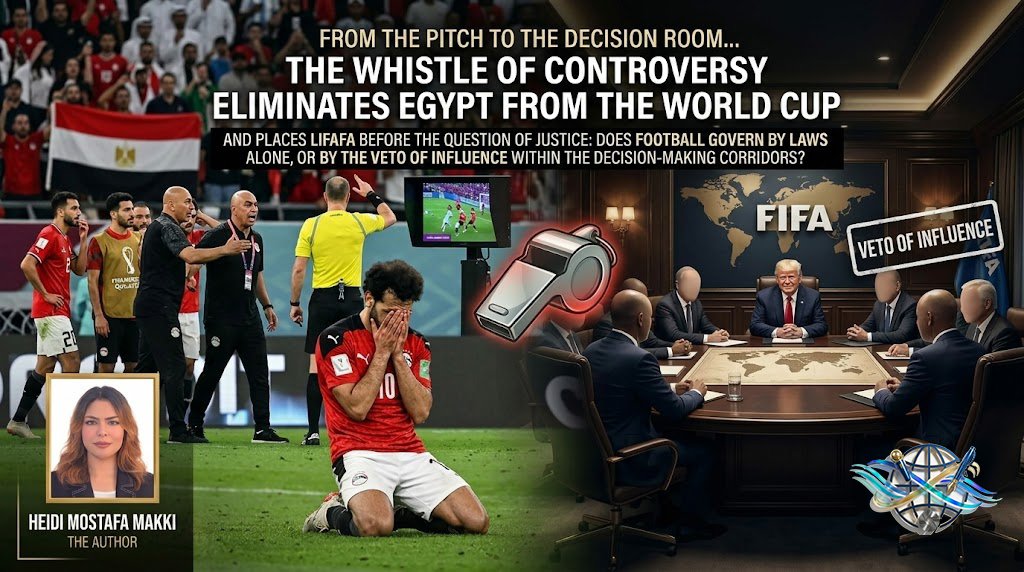
From this perspective, the controversy surrounding the Egypt–Argentina World Cup match should not be viewed merely as an emotional reaction to the loss of a match, but rather as part of a broader global discussion about sporting justice and the need to develop oversight and review mechanisms within the world’s largest football institution, the Fédération Internationale de Football Association (FIFA).
Egypt and Argentina… When the Referee Becomes the Headline of the Match
The Egyptian national team entered its match against Argentina fully aware of the magnitude of the challenge posed by an opponent with a distinguished international history and extensive experience in major tournaments. However, the performance on the field proved that theoretical differences do not always translate into inevitable superiority.
The Egyptian team delivered a strong performance characterized by discipline, courage, and the ability to compete with one of the world’s elite teams. This led many fans to believe that the team did not lose because of a difference in quality, but rather because of a series of small details in which certain refereeing decisions played a significant role.
The most controversial moments centered on several incidents that influenced the course of the match, including the penalty awarded to Argentina, the differing standards applied in judging fouls and issuing yellow cards between the two teams, and the interventions of the Video Assistant Referee (VAR) in several situations, particularly the disallowing of an Egyptian goal while other controversial decisions remained in Argentina’s favor.
Herein lies the real issue: it is not the existence of a refereeing mistake in itself, for human error is part of football, but rather the absence of convincing explanations and sufficient transparency regarding decisive decisions.
The essence of the crisis is not limited to the decisions made in a single match, but rather concerns a broader principle: consistency in the application of standards. Fans do not demand that their national teams always win; they demand that all teams be subject to the same rules and that decisive decisions be based on a clear methodology that can be explained and reviewed.
From Refereeing Errors to a Crisis of Confidence
The history of football is filled with controversial refereeing decisions, some of which have become part of the sport’s collective memory. The difference today is that technology was introduced to reduce errors, not to reproduce controversy in a new form.
The primary objective of the Video Assistant Referee (VAR) system was to achieve a greater degree of fairness. However, the lack of clarity in explaining certain decisions has led fans to ask:
- Are the same standards applied to all national teams?
- Does the handling of similar incidents differ according to the importance of the match or the identity of the competing teams?
- Does the refereeing system require greater independent oversight?
These questions are not unique to the Egyptian national team. They have become common among fans and national teams around the world, particularly when controversial decisions occur during the knockout stages of major tournaments.
FIFA Between Governing the Game and Preserving Credibility
Today, FIFA represents one of the most powerful sporting institutions in the world. It does not merely organize football matches; it oversees a massive economic industry encompassing broadcasting rights, sponsorships, advertising, and sports investments.
For this reason, FIFA’s responsibility extends beyond organizing competitions to safeguarding public confidence in the integrity of those competitions.
The concept of sporting justice does not mean that every team will obtain the result it desires, nor does it mean eliminating the referee’s authority. Rather, it means ensuring that major decisions are subject to review, that standards are clear, and that everyone feels the rules are applied equally to all.
The Arab Economy and Its Role in Global Football
The growing role of the Arab region within the international football landscape cannot be overlooked. The Arab world has become one of the game’s most important global markets through television broadcasting rights, commercial sponsorships, sports investments, and its vast fan base, which represents a major source of strength for international football competitions.
From this perspective, calls for justice and transparency are not merely emotional reactions from supporters; they are also linked to a fundamental principle of sports governance: everyone who contributes to the success of the global football system deserves to feel that their voice is respected and that competition is fair.
Moreover, the greater the contribution of any region or market to the success of the global sports system, the greater the need to ensure that its supporters feel their voices are respected and that justice is not determined by the size of influence or economic power.
Does World Football Need Institutional Reforms?
The recurring controversy surrounding refereeing decisions highlights the need to develop the oversight system within world football.
Among the proposals advocated by many observers are:
- Publishing official explanations after major matches regarding controversial refereeing decisions.
- Developing independent review mechanisms to evaluate the performance of referees in major tournaments.
- Standardizing the criteria governing the use of the Video Assistant Referee (VAR) across all matches.
- Enhancing transparency in disciplinary decisions and tournament regulations.
- Involving independent experts in assessing the performance of the refereeing system.
Great institutions preserve their strength not only through success, but also through their ability to confront difficult questions and address weaknesses.
Between Sporting Influence and Fans’ Concerns
Whenever refereeing controversies continue to recur, supporters begin asking questions that go beyond the football pitch: Are there balances of power within world football that indirectly influence decisions? Do certain national teams or football associations enjoy greater influence than others?
No definitive conclusions can be drawn without clear evidence. However, the mere existence of these questions is, in itself, an important indication of the need for greater transparency. Confidence in institutions is not built merely through denial, but through the availability of information, openness to review, and demonstrating that everyone is subject to the same rules.
The British newspaper The Sun highlighted the anger that swept through the Egyptian national team’s camp following its elimination from the World Cup in the Round of 16 against Argentina, noting that the Pharaohs’ players and members of the technical staff strongly criticized French referee François Letexier over a number of decisions that generated widespread controversy during the match.
According to the newspaper, Zizo left the pitch in a state of emotional collapse, expressing his frustration over what he described as an unfairly officiated match, particularly after an Egyptian goal was disallowed due to an alleged foul at the beginning of the attacking move, in addition to the referee’s failure to award a penalty that the Egyptian team claimed for Mohamed Salah before Argentina scored the winning goal in the closing minutes.
According to The Sun, Zizo believed that the referee had shown bias from the very beginning of the match. He stated that Egypt deserved fairer treatment, adding that losing is acceptable when it results from genuine footballing superiority, but that controversial refereeing decisions make the situation entirely different.
The newspaper also reported that the frustration was not limited to the players, but extended to the technical staff after the referee showed a red card to one of its members following repeated protests against several of his decisions during the match.
The report further highlighted the statements of Egypt’s head coach, Hossam Hassan, who expressed his dissatisfaction with the refereeing performance, emphasizing that his team did not receive full justice on the field and that the decisive refereeing decisions had undermined the players’ efforts.
The newspaper concluded by stating that the Egypt–Argentina Round of 16 match would remain one of the most controversial fixtures of the tournament after Egypt’s two-goal advantage turned into a 3–2 defeat amid widespread objections to several refereeing decisions.
A Call for an Immediate and Comprehensive Investigation
In light of the scale of the controversy surrounding the Egypt–Argentina match, the primary demand is not to rewrite the result of the match or to diminish the achievements of any national team, but rather to protect the future of the game and ensure that similar controversies are not repeated.
Accordingly, there is a need to open an immediate, comprehensive, and independent investigation by the competent authorities within the Fédération Internationale de Football Association (FIFA) to review:
- All controversial refereeing decisions that occurred during the match.
- The decision-making process of both the referee and the Video Assistant Referee (VAR).
- The extent to which those decisions complied with the applicable Laws of the Game and approved refereeing standards.
- The evaluation of the refereeing team’s performance in accordance with clear professional criteria.
The findings of this review should also be announced transparently to the sporting public, because silence regarding major controversies leaves greater room for speculation and erodes public confidence.
Justice Is Not a Slogan… It Is the Foundation for the Continuity of the Game
Football does not survive solely through goals and victories; it survives through the trust of the millions who follow it around the world. A national team that loses because its opponent was superior earns everyone’s respect. However, when a team or its supporters believe that factors beyond sporting performance influenced the outcome, they inevitably lose part of their faith in the fairness of the competition.
Therefore, the refereeing controversy surrounding the Egypt–Argentina match should not be dismissed as an isolated incident. Instead, it should serve as an opportunity for a broader review of the system of sporting justice within world football.
The objective is not to attack FIFA, but rather to encourage it to move toward greater transparency, because the strength of any global institution is measured not only by its ability to organize tournaments, but also by its ability to ensure that everyone believes the football pitch is the only place where results are decided.
Ultimately, the credibility of world football is not measured solely by the number of tournaments it organizes, but by the confidence of millions around the globe that justice—both on and off the field—is the rule, not the exception.
Discover more from المنتدى الدولى للصحافة والإعلام
Subscribe to get the latest posts sent to your email.