
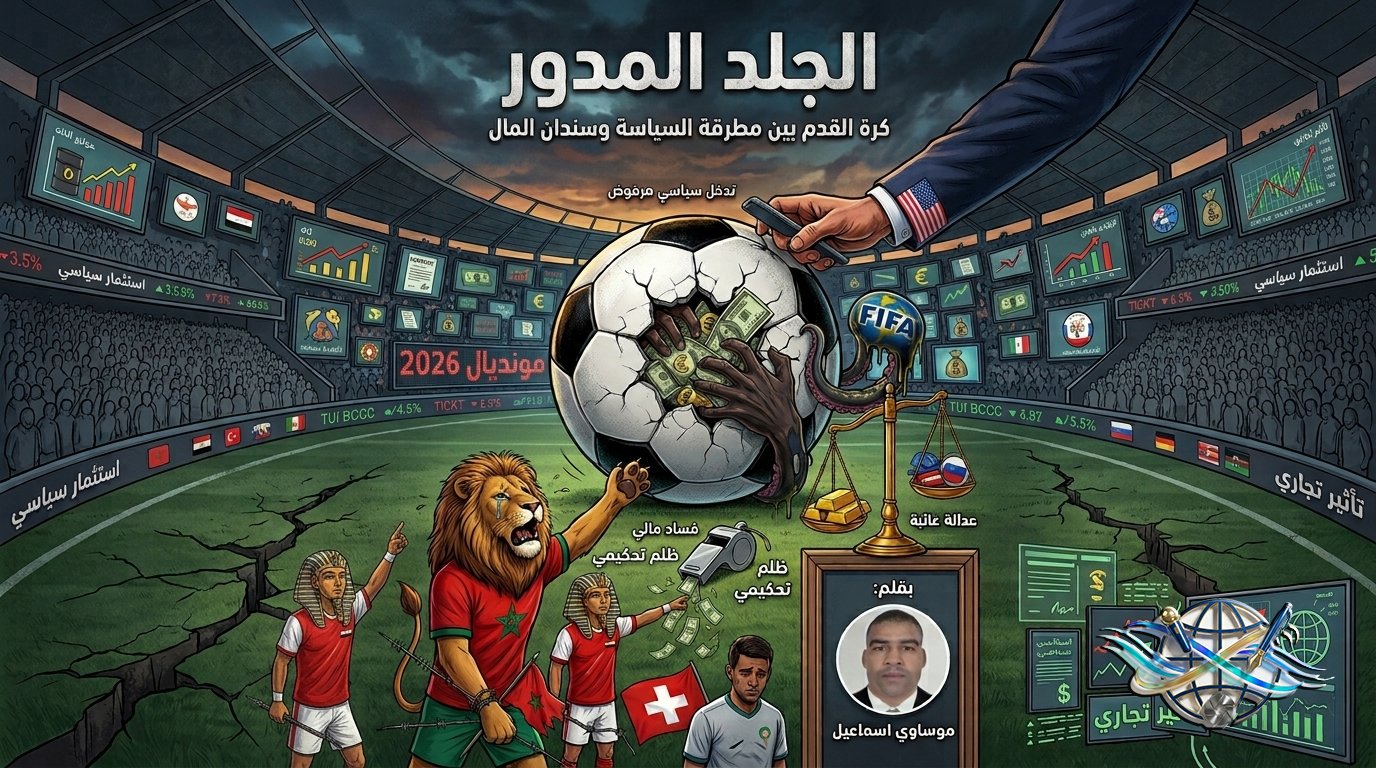
 By: Moussaoui Ismail
Football has gained its position as the most popular sport and as a representation of transparency and democracy. However, today it faces major challenges that threaten its beauty, integrity, and even its essence and part of its spirit.
Since we have unfortunately begun witnessing practices that have nothing to do with this game, the 2026 World Cup has revealed a blatant and unacceptable political interference, with politics interfering in sport by the host country, which intervened with its political weight to impose its vision on the organizer, in a clear violation of the neutrality of the game.
This was represented by the phone call made by U.S. President Donald Trump to the FIFA President, requesting intervention in the decision to suspend the American player Folarin Balogun. This practice sparked worldwide controversy and revealed the inability and silence of the continental federations (except UEFA and the Belgian Football Association, of course).
The International Federation of Association Football (FIFA) has become a hostage to financial and profit interests, sponsorship and advertising contracts, commercial revenues, various service fees, broadcasting rights, licenses, and others, at the expense of the ideal sporting and ethical values.
This action is sufficient to cast doubt on the credibility of the highest international sporting body and on its independence, with complete boldness and responsibility.
Amid these circumstances, the journey of the Moroccan national team in the 2026 FIFA World Cup finals came to an end in the quarter-finals against the French national team.
The objective reading of the Moroccan team in the current edition confirms a remarkable qualitative development. This time, the Atlas Lions have acquired the mentality and personality of winning and competing equally against opponents, away from a mentality of defending more, thanks to a young and talented squad that possesses all the necessary elements, including fitness, competitive experience, and the ability to come back in results.
However, the match in which the Atlas Lions were eliminated in the quarter-finals against the French national team raised a lot of discussion, as all these qualities disappeared or were disrupted, which raises more than one question.
Since I am not a technician or an expert in the game, but rather a spectator and a good follower, I find that the performance of the Moroccan national team against the French national team was truly dull and did not reflect its usual level as an equal competitor team that takes the initiative to score and seeks the result, as if it was waiting for a miracle.
It was absent mentally and competitively in the match against the strong French side.
As the saying goes: “Every horse has its stumble.” This is what happened to the respected Moroccan coach Mohamed Wahbi, who was unsuccessful in managing the match and in the substitutions he made, which, according to experts, contributed to the failure to come back in the result. Therefore, he bears responsibility for the defeat first, followed by his staff secondly.
In the same context of the game, the Egyptian national team faced the old-new scenario of refereeing injustice in football.
Instead of the Egyptian-Argentine competition being a technical football confrontation on the pitch, it turned into a refereeing massacre with suspicious and biased decisions in favor of the Argentine national team.
Egypt was deprived of a goal and a penalty kick, and there was no return to the VAR technology, as is done with mistakes that are in favor of Argentina.
This is truly an unfair and unequal competition, and therefore Argentina’s victory is undeserved, at the expense of the Pharaohs, who demonstrated their superiority by defeating the Tango team, had it not been for the refereeing mistakes.
Continuing the explicit violation of the neutrality of the game, the Swiss national team was not spared this time in the quarter-finals.
It was deprived of a goal and a valid penalty kick, in contrast to an illegal Argentine goal that was awarded to the Tango team, in addition to the controversial sending-off of player Breel Embolo in the second half, which contributed greatly to the elimination of the Swiss team.
In conclusion, in order for the game to regain its lost democracy, the spirit of football, and its sporting justice, a comprehensive review is required, fundamentally regarding the criteria for applying the laws of the game in the same way to everyone, with integrity, democracy, and complete transparency.
This is necessary to achieve justice and equality among all national teams, without favoritism, bias, or discrimination toward this team or that team, regardless of its history and achievements, or the size of its country, political weight, economic influence, or otherwise.
If FIFA wants to preserve its prestige and credibility, otherwise the continuation of such mistakes in the future will undoubtedly accelerate the loss of what remains of its credentials and the remainder of its legitimacy among the global audience.
Discover more from المنتدى الدولى للصحافة والإعلام
Subscribe to get the latest posts sent to your email.