

 Dr. Issam Al-Barram – Writer and Academic
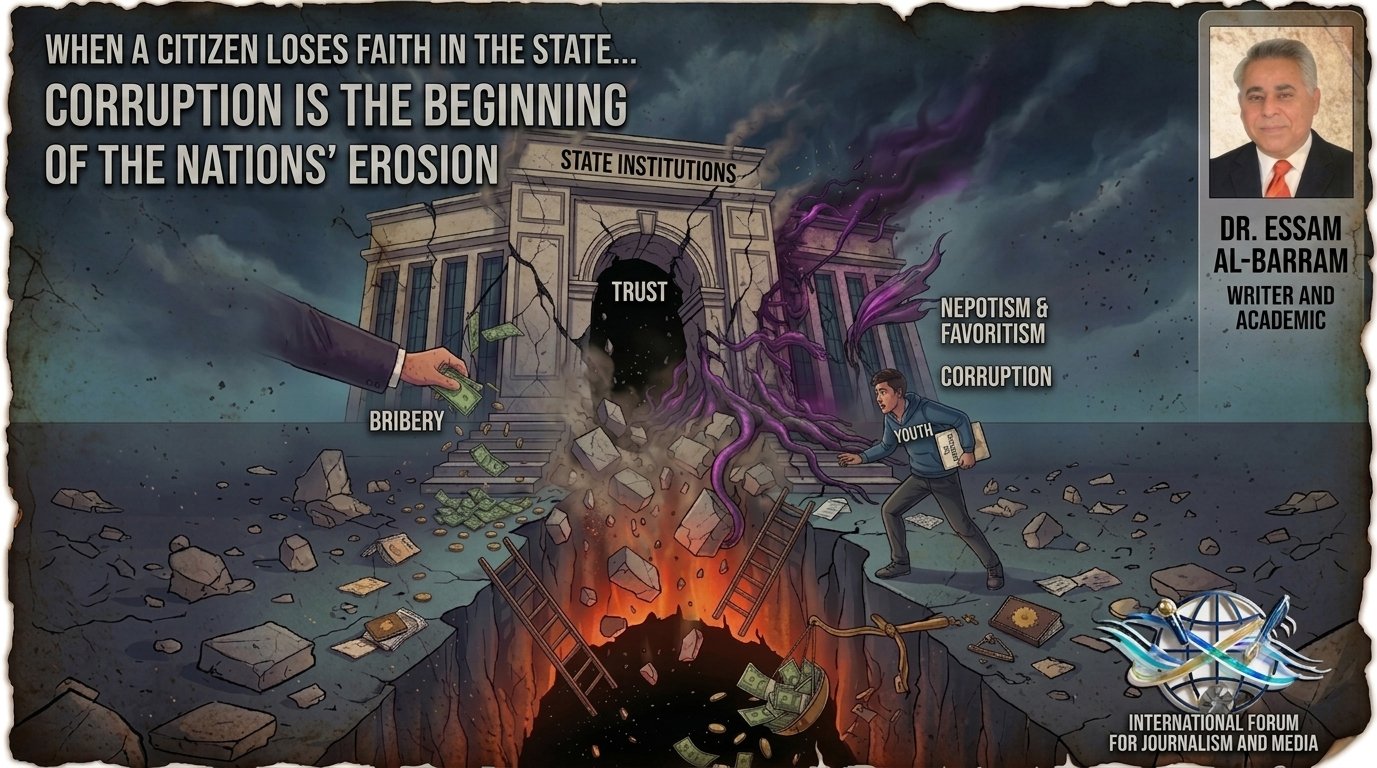
Nations do not begin to collapse solely because of economic crises or political instability. Their real decline begins when citizens lose confidence in their state’s institutions. Such trust does not disappear overnight; rather, it gradually erodes as corruption spreads through the machinery of government, and as citizens come to believe that the law is not applied equally to everyone, and that rights are obtained through favoritism, bribery, or influence rather than merit and justice. The greatest danger posed by corruption, therefore, is not merely the amount of money stolen, but the amount of public trust that is lost. Trust is the very foundation upon which the relationship between the state and its citizens is built.
Corruption is not simply an administrative violation or a financial crime. It is a destructive culture that, if left unchecked, evolves into everyday behavior that threatens public values and normalizes unethical practices. Once a state reaches this stage, reform becomes far more difficult because corruption has not only infiltrated institutions but has also penetrated patterns of thinking, the management of interests, and the relationships within society.
Corruption Undermines the Relationship Between Citizens and the State
The modern state is founded on an unwritten social contract between citizens and governing institutions. Under this contract, citizens are expected to obey the law, while the state is responsible for ensuring justice, security, public services, and equal opportunities. This balance is disrupted when people perceive that the law is enforced selectively or that certain individuals receive privileges they do not deserve because of their influence or personal connections.
When such situations become commonplace, citizens begin to lose confidence in public institutions. Their sense of belonging and civic responsibility diminishes, and they become increasingly inclined to seek individual solutions to their problems—even if those solutions fall outside the law. As a result, the authority of the state gradually weakens, since respect for the law is inseparable from public confidence in its fairness and in the integrity of those responsible for enforcing it.
Corruption also generates frustration among young people, especially when they see that competence, hard work, and dedication are insufficient to secure employment, promotion, or success, while favoritism and nepotism achieve what merit cannot. This frustration undermines productivity and innovation and often drives highly qualified individuals to emigrate in search of societies that value fairness and recognize their abilities. Consequently, the state loses one of its greatest assets: its skilled human capital.
Strong Institutions Cannot Coexist with Corruption
The strength of a nation is measured not only by its natural resources or economic potential but also by the ability of its institutions to operate according to the principles of law, transparency, and efficiency. Any institution that tolerates corruption gradually loses its capacity to perform effectively because decisions become driven by personal interests rather than the public good.
The consequences soon become evident through bureaucratic delays, declining public services, postponed projects, escalating costs, and disappointing outcomes. Over time, these deficiencies evolve into burdens that weigh heavily on the state and directly affect the daily lives of its citizens.
The impact of corruption is never confined to a single institution. Weakness in one institution inevitably affects others. When oversight deteriorates, violations become more widespread. When justice weakens, respect for the rule of law declines. When administrative competence is absent, the quality of education, healthcare, infrastructure, and investment suffers, trapping the nation in a cycle that can only be broken through comprehensive reform.
Building strong institutions therefore requires appointing leaders based on integrity, competence, and experience, strengthening accountability, and refusing to tolerate any violation regardless of the offender’s status. Tolerance of minor corruption inevitably opens the door to more serious forms of corruption that become increasingly difficult to contain.
Leadership’s Responsibility in Restoring Trust and Combating Corruption
The primary responsibility for combating corruption rests with the highest levels of national leadership, as well as with the heads of public and private institutions. Genuine reform begins at the top and influences every level of administration. It is the duty of a head of state—or the leader of any institution—not merely to monitor outcomes, but to continuously investigate the root causes of theft, financial misconduct, and administrative violations within public institutions and address them before they become systemic problems.
It is equally essential to examine the reasons behind the spread of bribery between some citizens and government institutions. These may include overly complicated procedures, weak oversight, lack of accountability, poor administration, or abuse of authority. Identifying the root causes is the first step toward effective reform, because any reform effort that is not based on an accurate diagnosis of the problem will inevitably remain incomplete.
Restoring public trust also requires greater transparency in the management of public funds, clear disclosure of the outcomes of corruption investigations, and the impartial application of the law without exception. Justice that is visible and consistently enforced reassures citizens that the state protects their rights and safeguards their interests.
Digital transformation in the delivery of government services also represents one of the most effective tools for reducing corruption. By minimizing direct human interaction, digital systems reduce opportunities for bribery and extortion, accelerate service delivery, improve procedural accuracy, and ensure that all transactions remain transparent and fully auditable.
At the same time, society shares responsibility by promoting a culture of integrity, encouraging the reporting of misconduct, and rejecting bribery as a means of facilitating transactions. Regardless of how many laws or oversight agencies exist, the state cannot succeed alone unless society becomes an active partner in protecting public resources and reinforcing the values of honesty and responsibility.
Countries that have successfully reduced corruption have achieved this not through punishment alone, but by cultivating an institutional culture grounded in transparency, efficiency, and accountability, while making integrity an essential component of national identity and a defining standard for success in public service.
Corruption is therefore not merely a threat to the present—it is a direct threat to the future of the nation and its coming generations. It squanders national wealth, weakens institutions, undermines public trust, obstructs development, jeopardizes security and stability, and discourages investment and economic growth.
For this reason, the fight against corruption is not simply a political or administrative choice; it is a national necessity for safeguarding the state, strengthening its standing, and reinforcing the rule of law. The more successfully national leadership establishes the principles of integrity, transparency, and accountability, the stronger the state becomes, the greater the confidence of its citizens, and the more sustainable the process of nation-building and development. Nations are not built by resources alone; they are built first and foremost through honest governance, strong institutions, and sincere leadership that places the public interest above all else.
Discover more from المنتدى الدولى للصحافة والإعلام
Subscribe to get the latest posts sent to your email.