
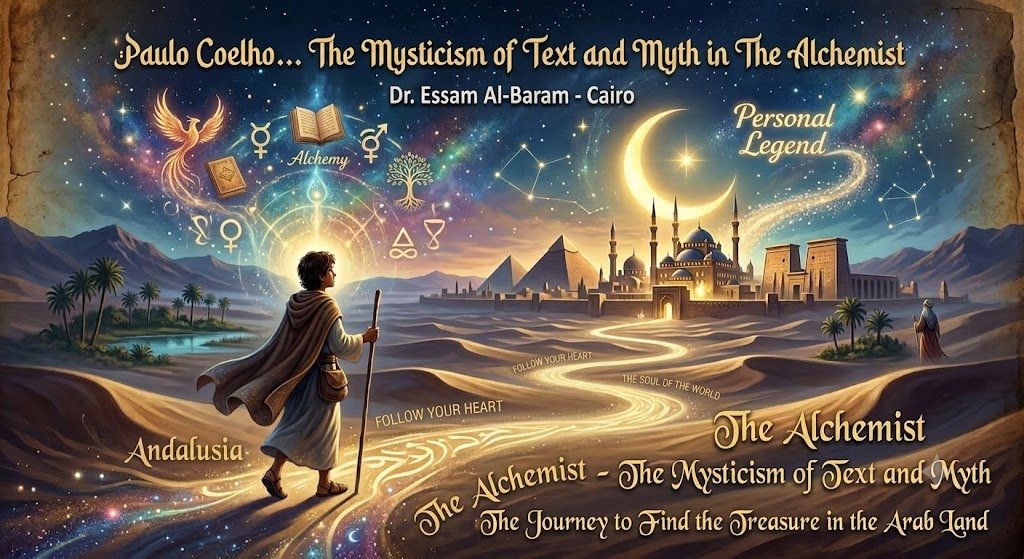
 Dr. Essam Al-Barram
Before embarking on a reading of The Alchemist by the Brazilian writer Paulo Coelho, it is important to acknowledge that Arabic literature—with its vast intellectual heritage, both ancient and modern—has made a profound contribution to world literature. The immense body of novels, stories, myths, and folk narratives created by Arab writers has undoubtedly influenced the development of global literary traditions, whether directly or indirectly.
From the ancient Mesopotamian Epic of Gilgamesh to One Thousand and One Nights, as well as the rich oral traditions of Mesopotamia and the broader Arab world, one can clearly discern echoes of these narratives in numerous Western and international literary works. Many authors have drawn inspiration from the essence of these stories, reinterpreting them through modern narrative techniques while preserving their universal human themes.
A close reading of The Alchemist reveals narrative threads that evoke the spirit of One Thousand and One Nights and, perhaps more specifically, the adventures of Sinbad the Sailor. Although Coelho’s narrative structure, characters, and contemporary style differ significantly from classical Arabic storytelling, the underlying concept of the spiritual journey bears a striking resemblance to those timeless tales.
The central idea of The Alchemist unfolds through the protagonist’s quest, his hardships, and his search for a hidden treasure in the Arab world. For readers familiar with Arabic literary heritage, Santiago’s expedition inevitably recalls the adventurous voyages of Sinbad, where every challenge becomes both a physical and spiritual test.
The Alchemist blends fantasy, wonder, symbolism, and philosophical reflection, making it one of the most influential literary works of modern times. The novel tells the story of Santiago, a young Andalusian shepherd who abandons his peaceful life in Spain after recurring dreams urge him to seek a hidden treasure near the Egyptian pyramids. Crossing North Africa and the Arab desert, he embarks upon a transformative journey through the landscapes of ancient civilizations.
Yet the novel is far more than an adventure story. It is an inward journey toward discovering life’s true purpose. Throughout his travels, Santiago learns that the treasure he seeks is not merely material wealth, but self-discovery, spiritual fulfillment, and the realization of one’s destiny.
Coelho portrays Santiago as an ordinary young shepherd whose determination to pursue his dream gradually shapes his character. Every obstacle, disappointment, and encounter strengthens his inner conviction and deepens his understanding of himself and the world around him.
One of the novel’s greatest strengths lies in its philosophical depth. It explores themes such as spiritual awakening, destiny, personal transformation, perseverance, and the search for meaning. Through Santiago and the other symbolic figures he encounters, Coelho invites readers to contemplate the relationship between human beings and the universe.
The novel suggests that true treasure is not measured by gold but by inner enlightenment, faith, courage, and the will to pursue one’s Personal Legend. Destiny, in Coelho’s vision, is not a prison but a calling that requires faith, resilience, and action.
Mysticism permeates the narrative. Characters such as the mysterious king and the alchemist serve as spiritual guides, encouraging Santiago to understand the hidden language of the universe. Their presence reflects Coelho’s synthesis of Eastern spiritual philosophy with his own literary imagination, creating a narrative that bridges mystical traditions and contemporary storytelling.
Symbolism is another defining feature of the novel. The treasure represents life’s highest purpose, while the desert and the sea symbolize the trials that every individual must overcome to achieve personal fulfillment. These symbols enrich the novel’s philosophical dimensions while reinforcing its universal appeal.
Coelho masterfully employs myth and allegory, infusing the narrative with an atmosphere reminiscent of the legends and folklore of the East. His prose combines simplicity with poetic elegance, making complex philosophical concepts accessible without diminishing their depth.
The novel also emphasizes personal growth and spiritual development. Through Santiago’s internal struggles, readers are encouraged to reflect upon their own aspirations, recognize the importance of self-discovery, and appreciate the profound relationship between humanity and the cosmos.
Despite its philosophical richness, The Alchemist maintains an engaging and accessible narrative style. Coelho’s language is clear, concise, and emotionally resonant, allowing readers from diverse backgrounds to connect with its universal message. The gradual unfolding of the story creates a harmonious balance between reality and fantasy, immersing readers in a world where ancient myths, spiritual wisdom, and human ambition coexist.
The author’s ability to generate empathy between readers and his characters contributes significantly to the novel’s enduring popularity. Mythological elements function not merely as decorative motifs but as meaningful symbols that deepen the narrative and elevate its artistic complexity.
Since its publication, The Alchemist has profoundly influenced contemporary world literature. Translated into dozens of languages and read by millions, it has become a literary reference for readers and writers alike. Its enduring popularity stems from its timeless reflections on faith, perseverance, self-realization, and the pursuit of dreams.
The novel continues to inspire readers by emphasizing the transformative power of belief, determination, and passion. It demonstrates that the greatest discoveries are often made within oneself rather than in the external world.
Through its rich philosophical themes—including destiny, spiritual transformation, symbolism, enlightenment, and the interconnectedness of humanity and the universe—The Alchemist has secured its place among the most influential literary works of the modern era, captivating generations of readers across cultures and continents.
Discover more from المنتدى الدولى للصحافة والإعلام
Subscribe to get the latest posts sent to your email.