
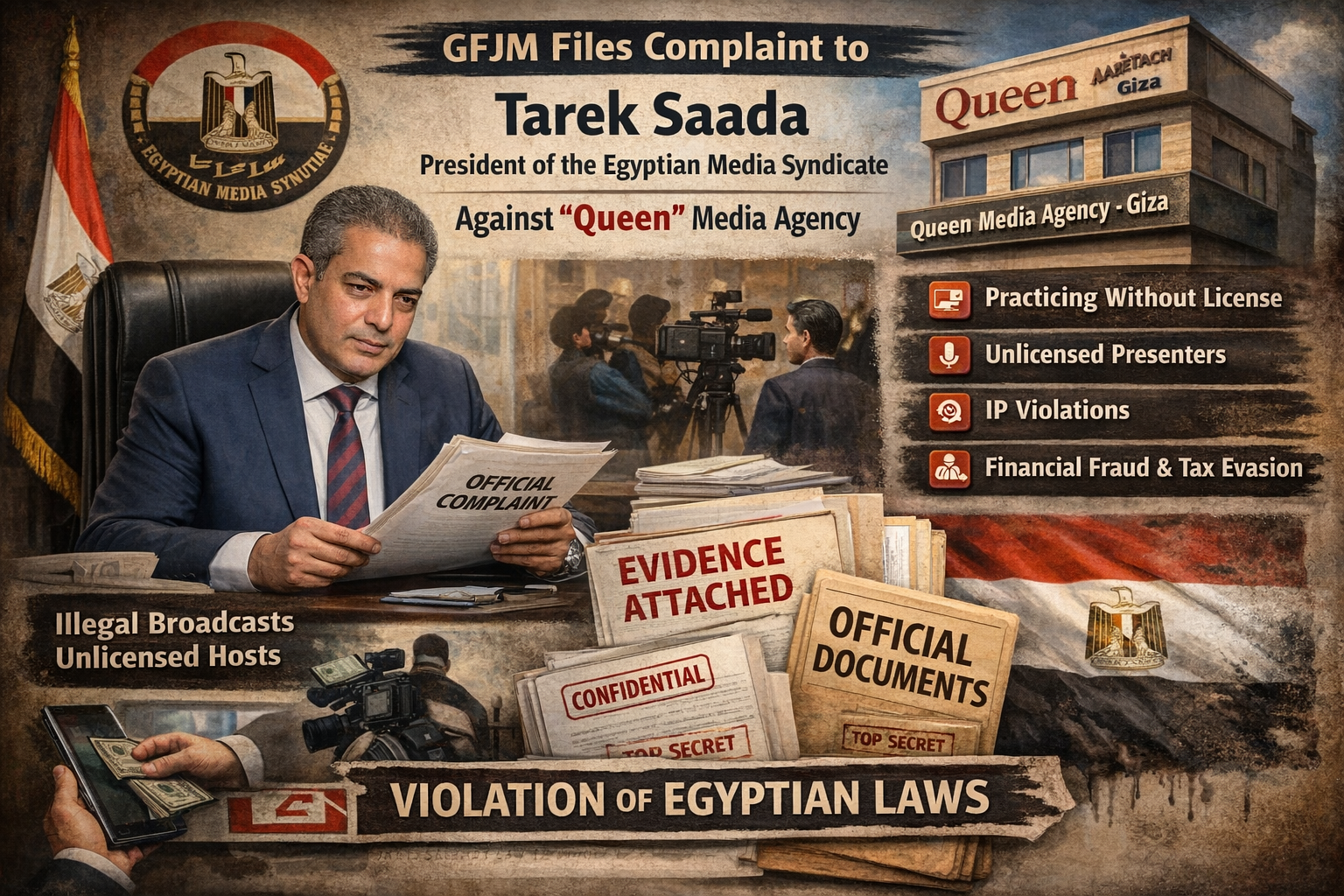
The Global Forum for Journalism and Media (GFJM) submitted an official complaint to Tarek Saada, President of the Egyptian Media Syndicate, against the media agency “Queen,” accusing it of violating Egyptian laws and engaging in illegal media activities, including financial fraud and harming the reputation of the state, according to official documents and attached evidence. Dr. Tarek Saada, President of the Syndicate, received the complaint with openness and promised that he would take all the necessary measures.
The “Queen” agency is located in Giza Governorate – Al-Haram District, Giza – 2 Hassan Al-Qadi Street – First Floor, Apartment 8. It holds Commercial Registration No. 127624 and Tax Card No. 337694516, and is managed by Mrs. Abeer Hamed Ahmed Ali, with contact number 01017275314.
Multiple violations threatening Egyptian media
Practicing media without a license
The complaint explained that the agency broadcasts programs through channels such as “New Capital” and “Republic TV” and other channels without obtaining official licenses, in a clear violation of Egyptian law. This violation does not only affect the legal aspects but also threatens the credibility of Egyptian media before local and international audiences.
Employing unlicensed presenters
The agency presents programs hosted by presenters who have not obtained permits from the Egyptian Media Syndicate, which constitutes a direct violation of the rules governing the practice of the media profession. This practice raises questions about the level of professionalism within the agency and may harm the overall standard of journalism and media in Egypt.
Violation of intellectual property rights
The agency broadcasts programs and media and artistic materials without the consent of the rights holders, which is a clear violation of national and international laws and reflects the agency’s disregard for the principles of copyright and professional ethics.
Illegal appropriation and international fraud
The complaint highlighted repeated attempts by the agency and its director to seize money unlawfully from individuals outside Egypt. Some of these operations resulted in the actual appropriation of specific sums of money, with other failed attempts in countries such as Canada, Morocco, and Western Sahara. These violations add an international dimension to the case and fall under cross-border financial crimes.
Harming the reputation of the state
The media violations include broadcasting low-quality content that harms the image of the Egyptian state internationally, which puts the state’s reputation at stake and reflects the agency’s disregard for the national dimensions of its media work.
Tax evasion
Evidence indicates the possibility that the agency is not complying with the taxes due on its media and commercial activities, which constitutes an additional violation of financial laws and increases the scale of the violations.
The forum’s demands
The forum called on the Egyptian Media Syndicate and the regulatory authorities to:
- Conduct an immediate investigation into the legal violations of the media agency and its affiliated channels.
- Take disciplinary measures including preventing the agency from practicing any media activity until its legal status is corrected.
- Inform the competent regulatory authorities to ensure the protection of Egyptian media and the reputation of the state.
- Follow up on legal procedures to recover the funds that were seized and compensate the affected individuals for any financial losses.
This case highlights gaps in media and legal oversight that may be exploited by some agencies to achieve financial gains at the expense of professional credibility and the reputation of the state. It also shows that the spread of unlicensed media and violations of intellectual property rights are not merely administrative violations, but constitute a tangible threat to media security and public trust in media institutions.
This complaint comes at a critical time, as the importance of legal and professional oversight of media continues to grow in order to ensure the protection of individuals’ rights and the state, and to preserve standards of integrity and credibility.
Full commitment of the forum
The Global Forum for Journalism and Media (GFJM) confirmed that it has attached all documents and evidence proving the violations and that it is ready to provide any additional documents or testimonies to support the complaint when required, emphasizing that protecting Egyptian media and the rights of those affected is a top priority.
 Loading...

 Reload document
  Open in new tab
 Discover more from المنتدى الدولى للصحافة والإعلام
Subscribe to get the latest posts sent to your email.