
 Dr. Hany Khater – President of Global Forum for Journalism and Media
Islamophobia as a Complex Phenomenon
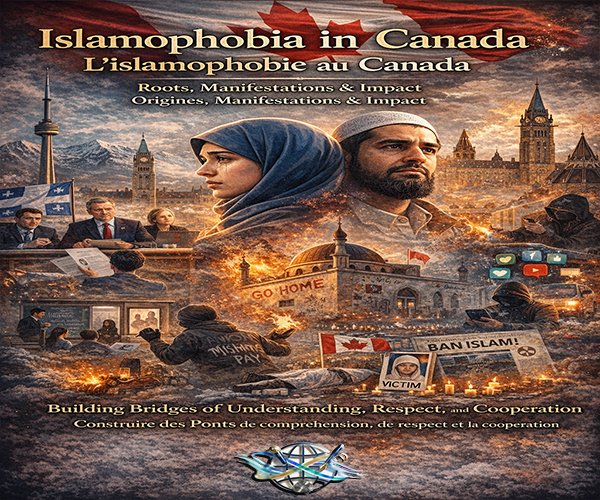
In recent years, the term Islamophobia has risen in public discourse in Canada and has become an important political, social, and cultural topic. Although Canada is known as a multicultural society, tensions related to fear and prejudice against Islam and Muslims remain part of social reality.
Islamophobia is not merely a hostile attitude toward a religious group; it is a set of ideas and practices that affect social relations, public policies, and community cohesion.
Today, Islamophobia in Canada goes beyond being an “individual feeling” to become an institutional challenge that tests the strength of the Canadian Charter of Rights and Freedoms. It is a phenomenon fueled by the gap between official discourse celebrating diversity and field practices that may marginalize Muslim identity, making it a national and social security issue that requires structural solutions beyond slogans.
Islamophobia and Its Intellectual Foundations
Islamophobia means fear, bias, or unjustified hostility toward Islam and Muslims. This phenomenon manifests in a range of behaviors, including:
- Discrimination in interactions
- Negative generalizations and stereotyping
- Verbal and physical assaults
- Hate speech in public spaces
The origins of this phenomenon are multiple and include:
- Political associations with the so-called “war on terror”
- Shifts in media discourse
- Fluctuations in cultural exchange and communication between different groups
It is a phenomenon that interacts with the historical and cultural framework in Western countries, including Canada.
Intellectually, Islamophobia is based on the “othering” of Muslims, portraying them as foreign to “Western” or “Canadian” values. This intellectual basis is reinforced through conspiracy theories (such as the Great Replacement theory) that resonate with some far-right currents, turning hostility from an individual level into organized political ideology.
The Canadian Context: Between Pluralism and Social Challenges
Canada is a multicultural country whose policies are based on celebrating diversity and respecting religious and cultural rights. However, social reality is more complex than official policies suggest. In Canada:
- Muslims live as part of a diverse society
- Perspectives vary between conservatives and liberals regarding the role of religion in the public sphere
- Secular values (especially in Quebec) sometimes clash with expressions of religious identity
These differences make Islamophobia a social issue that requires careful understanding of history, values, and local tensions.
The conflict in Canada emerges between “federal multiculturalism” and models of “exclusionary secularism” in some provinces. This tension creates what sociologists call “conditional citizenship,” where Muslims are sometimes required to prove their loyalty to Canadian values more than others, generating a sense of alienation within the same country.
Media and Islamophobia: Distorted Image or Legitimate Critique?
The media plays a pivotal role in shaping public opinion. In some cases, the media contributes to:
- Reinforcing stereotypes associated with Islam by linking the religion to extremism
- Focusing on negative news without balancing with the diversity of Muslim experiences
- Presenting events as facts without interpretive context
This occurs in conditions of increasing reliance on digital news and social media platforms, where misinformation spreads quickly, accelerating the formation of prejudgments among the public.
Conversely, the media can be a force for positivity if used to:
- Promote genuine understanding of Islam
- Highlight stories of success and diversity
- Debunk misinformation through science, knowledge, and careful analysis
Canadian media has an ethical responsibility to dismantle “unconscious bias.” Exclusive focus on Muslims in contexts of “security” or “integration” reinforces suspicion. What is needed is the “humanization” of media discourse by including Muslim voices in economic and cultural issues as natural partners, not just as parties in religious or security debates.
Practical Examples from Quebec
Among Canadian provinces, Quebec stands out in discussions of Islamophobia due to its cultural and political background related to secularism and cultural identity.
Quebec Mosque Attack in January 2017
In January 2017, an armed attack occurred at a mosque in Quebec City during prayer, resulting in the deaths of six worshippers and injuries to others. The incident was widely condemned as a hate crime targeting Muslims and had a profound impact on Canadian society, shaking Muslims’ sense of safety and reigniting discussion on the need to protect religious minorities.
Debate over “Religious Neutrality Law” No. 21
The law restricting the wearing of religious symbols in workplaces for government employees sparked wide debate. Some see it as an attempt to reinforce secularism, while others consider it a restriction on freedom of belief, particularly affecting Muslim women who wear the hijab.
These examples clearly show how public policies can intersect with feelings of belonging and identity, raising questions about the status of Muslims in society.
Law No. 21 in Quebec represents “institutionalized Islamophobia” in the eyes of many human rights advocates, as it disproportionately targets Muslim women and deprives them of economic rights (such as teaching or practicing law). This type of law legitimizes discrimination in the private sector as well and creates a legal barrier to full equality.
Manifestations of Islamophobia in Daily Life
Islamophobia does not only appear in major events or political debates but also in everyday life:
- Workplace discrimination: Muslims may face obstacles or prejudice when applying for certain jobs due to their name or religious appearance.
- School experiences: Muslim students may feel questioned or subjected to bias, whether by peers or curricula that do not reflect a true understanding of religious diversity.
- Online hate speech: Some platforms host posts or discussions targeting Islam as a religion or criticizing Muslims in general.
Statistics in Canada (such as those from Statistics Canada) indicate that hate crimes targeting Muslims are among the most physically violent. Digital Islamophobia has also fueled real-world assaults, as social media algorithms create echo chambers that reproduce and amplify hate.
Impact of Islamophobia on Canadian Society
Islamophobia affects not only Muslims but Canadian society as a whole:
A. Erosion of social cohesion: When a segment of society feels subject to prejudice or persecution, this weakens shared belonging and affects dialogue between groups.
B. Sense of insecurity and withdrawal: Experiencing discrimination may lead some to avoid participating in public life, affecting their engagement with broader society.
C. Threat to pluralism values: Canadian values are based on respecting diversity, but Islamophobia is a true test of these values, as it can limit religious and cultural freedom if left unchecked legally and socially.
Economically, Islamophobia leads to “brain drain”; when Muslim professionals face a glass ceiling preventing career advancement, Canada loses creative talent and weakens its domestic front against external interventions that may exploit societal divisions to destabilize the country.
How to Confront Islamophobia
Addressing Islamophobia requires multidimensional efforts from the following:
A. Education: Curricula should promote understanding of religious and cultural diversity and equip students with critical thinking skills to understand others without prejudice.
B. Responsible media: Media organizations should adopt balanced coverage, avoid stereotypes, and highlight cultural and religious diversity in society.
C. Public policies: Policies must ensure protection of religious and cultural rights without discrimination and enforce strict laws against hate speech and violence.
D. Intercultural dialogue: Organizing joint events among different religious and cultural communities can promote understanding and mutual respect.
E. Supporting constructive criticism: A clear distinction must exist between legitimate critique of policies or practices and hate speech targeting religious identity.
Practically, the role of the “Special Representative for Combating Islamophobia in Canada” should be activated, granting oversight authority over government policies. Major companies should adopt genuine (not symbolic) Diversity, Equity, and Inclusion (DEI) policies to ensure a bias-free work environment.
Pluralism in Canada as a Collective Responsibility
Islamophobia in Canada is not merely an academic topic; it is a real challenge affecting the fabric of society. The multiculturalism Canada prides itself on is not just a slogan but a daily path for social development, requiring all—governments, institutions, media, and civil society—to cooperate in protecting values of respect, freedom, and justice.
Ultimately, the question remains: will we be able to maintain pluralism as a real value practiced in daily life, not just a principle mentioned in documents and policies?
Discover more from المنتدى الدولى للصحافة والإعلام
Subscribe to get the latest posts sent to your email.