
 Dr. Abdul Karim Al-Wazzan
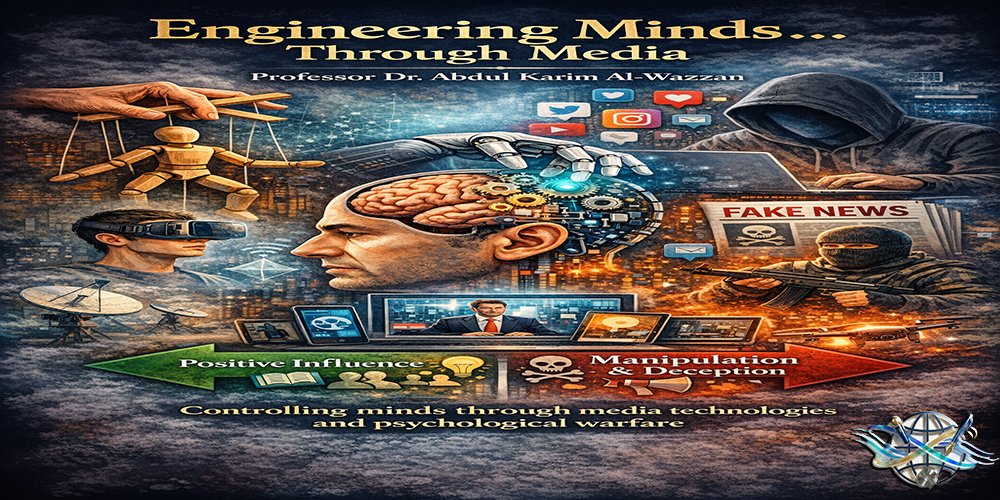
Mind engineering refers to a process of programming advanced perception, focusing on intellectual and cultural maturity, raising awareness, changing convictions, and directing people either negatively or positively depending on the purpose of this engineering – whether driven by political or commercial motives. Although the term engineering is commonly used in a positive sense, as it is associated with creativity and organization toward improvement, its negative side refers to manipulation, deception, and harmful psychological influence.
Technological progress and the rapid growth of media technologies in particular – including digital transformation, artificial intelligence, and even the metaverse – have helped accelerate and refine the process of shaping minds and reconstructing media awareness. This occurs through the delivery of structured communication messages with systematic and coherent media discourse, built on psychological and scientific foundations, and conveyed by a skilled communicator capable of generating positive feedback that aligns with the goals and intentions of the message and its sender.
These processes operate quietly, invisibly, and at far lower cost than traditional wars, often without clear accountability. They influence the recipient indirectly and without their awareness, gradually altering behavior and actions in ways that affect society. In this context, Dr. Mustafa Abu Salah wrote in his blog “Controlling Minds through Social Media Networks”:
“This hidden manipulation of people’s emotions has imposed a new form of social engineering whose effects we now see in our daily lives. Social media platforms have become fertile ground for strange ideas and fabricated or fragmented news spread by dark networks with specific agendas that exploit religion, sectarianism, and other issues. Many people—even educated ones—share these fabricated stories and unusual ideas without fully realizing what they are doing. The greatest danger lies in the impact on youth, who are more vulnerable to strange and extremist ideas due to limited experience, particularly during stages of intellectual development.”
Naturally, this aligns with methods of psychological warfare, which rely on the planned and strategic use of propaganda, rumors, political maneuvering, economic pressure, and deterrent military actions, along with other media measures designed to influence the opinions, emotions, attitudes, and behaviors of targeted audiences. These efforts ultimately serve the agenda of the entity behind this engineering – whether individuals, intelligence agencies, political or media institutions, or even individual states or alliances.
Thus, the media dimension becomes the decisive factor in either defending against or launching this form of mental engineering. This occurs through the exploitation of various forms of mass media – traditional and modern – alongside social media platforms, digital transformation programs, and artificial intelligence technologies to shape public opinion.
This reality requires the optimal and strategic use of media, beginning with governmental policies that treat media as both a field of thought and practice. Such policies should support research centers and scholars while empowering media professionals regardless of their specialties or roles. Methodologically, media studies should also be introduced as a subject in secondary schools to build a strong intellectual shield that protects society – especially young people, who represent the foundation of the community and the leaders of the future – from harmful media “waste.”
It is also essential to exchange experiences with Arab countries and strive toward a unified media discourse. Socially, family education and civil society organizations play a crucial role in preserving ethical and social standards and reinforcing educational values. Educational institutions, media organizations, and families must encourage audiences to become critical thinkers – questioning the constant flow of news, verifying videos and images, and avoiding blind imitation or emotional manipulation. Supporting media outlets that rely on credibility and neutrality is equally important. Only then can we truly remain free in our thinking.
Finally, it must be remembered that traditional wars have been gradually fading for quite some time, replaced by the ignition of psychological warfare and the engineering of minds. The most dangerous wars today are no longer fought on battlefields – but within human minds. This reality highlights the seriousness of the world we face and live in today.
So, are we truly prepared for it?
Discover more from المنتدى الدولى للصحافة والإعلام
Subscribe to get the latest posts sent to your email.