
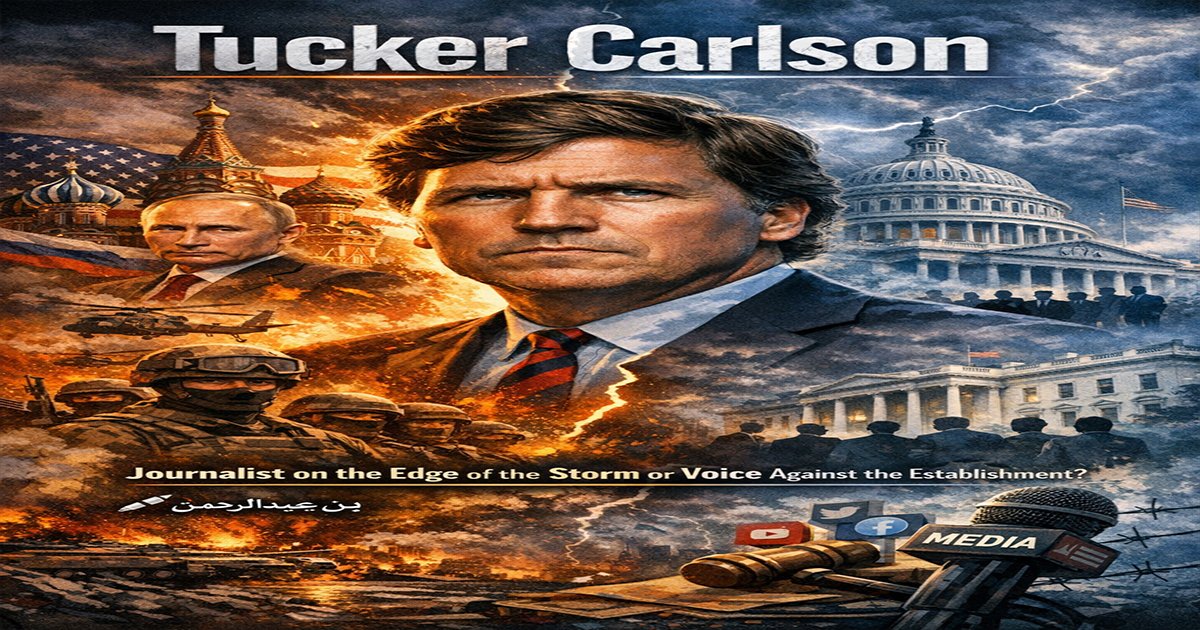
 🖋️ Ben Abdelrahman
In a media world dominated by grand narratives, where opinion often blends with news, the name Tucker Carlson emerges as one of the most controversial voices in the American political and media landscape over the past two decades. A man who did not settle for sitting behind the desk, but chose instead to flip the table—or at least question its foundations.
Since his beginnings in the 1990s, through his influential period at CNN, then his meteoric rise at Fox News, and finally his sudden departure from the network at the peak of his popularity, Carlson has remained a model of a journalist who believes his first duty is not “neutrality,” but “not lying.”
From Neutrality to “Not Lying”
Carlson, who began his journalistic career in 1991 with a traditional commitment to the concept of neutrality, says that his long experience changed his convictions. He no longer believes that a journalist must be “neutral” as much as he must be truthful.
In his view, the problem is not the existence of different opinions, but the presence of unspoken red lines that prevent certain questions from being asked:
• Why do American forces remain in some regions of the world?
• Why are decisions of war made without genuine public debate?
• Who determines the dominant media narrative?
For him, simply asking these questions was enough to place him in direct confrontation with the political and media establishment in his country.
“The Deep State” and the Elite… A Reading of Power Structures
Carlson does not believe in a traditional conspiracy theory, but he does believe that a “ruling elite” influences political and economic decisions. In his view, every state has an influential upper class, whether it appears as a clear monarchy or as a network of economic and security interests.
He compares the state to a large corporation:
Major shareholders hold the loudest voice, not the ordinary voter.
This perspective, which intersects with critical arguments about the Western liberal system, placed him in confrontation with many of his colleagues in American media.
The Dismissal Experience… A Pivotal Moment
Carlson reached the peak of his influence while hosting the most-watched program in the history of American cable news. Then came the moment of his dismissal from Fox News in 2023, without an official explanation.
He believes the decision was not related to ratings, but to differences in vision and narrative. He also states that he knew in advance that addressing certain issues—especially the war in Ukraine and Washington’s role—would cost him his position.
Despite this, he says he is grateful for that moment, because it granted him complete independence away from the constraints of major institutions.
The Putin Interview… Breaking the Taboo
One of his most controversial moments was his interview with Russian President Vladimir Putin, at a time when the Russia–Ukraine war was at its peak.
Carlson justified the interview as an attempt to allow the American public to hear the Russian perspective directly, arguing that American media had not provided that opportunity.
His critics saw the interview as promoting the Kremlin’s narrative, while he argued that preventing dialogue is more dangerous than allowing it.
In the same context, he expressed admiration for certain administrative aspects of Moscow, suggesting that comparing the performance of major cities could be a way to criticize domestic American performance.
Media Between Narrative and Power
One of his central arguments is that major media institutions do not operate solely for profit, but also serve the interests of the “real shareholders” within the political and economic system.
He believes media outlets construct a grand “story,” then distribute roles within it, while marginalizing fundamental questions that could threaten the system’s underlying structure.
He also argues that social media platforms face direct and indirect governmental pressure, whether in the United States, Europe, or elsewhere.
His Position on Israel and Foreign Policy
In one of his most controversial statements, Carlson criticized what he described as “excessive bias” by some American politicians toward Israel, particularly Israeli Prime Minister Benjamin Netanyahu.
However, he distinguishes—according to his view—between criticizing the policies of a foreign state and criticizing American officials who place external interests ahead of domestic ones.
He emphasizes that his anger is directed primarily toward the leaders of his own country, not toward the leaders of other nations.
Religion and Leadership… A Spiritual Dimension in His Discourse
Carlson, who describes himself as a committed Christian, often repeats a central idea:
“We are not gods… and we must not lie.”
He believes any civilization can be preserved through two principles:
1. Recognizing the limits of human beings before the Creator.
2. Refraining from lying to the public.
This spiritual dimension has become more visible in his discourse after leaving major networks, as he increasingly speaks about humility and acknowledging mistakes—including his previous support for the Iraq war.
Between Anger and Self-Reflection
Carlson does not hide that he is a sharp personality. He admits that he has lost his temper many times during his career and regrets some of his positions. However, he insists that his emotions—particularly his anger at what he considers leadership failures—are genuine and not a media performance.
He says that rapid fame in his youth was not healthy, and that public embarrassment can sometimes be a necessary lesson for maturity.
The Question of the Era: Toward a Multipolar World
In his reading of global transformations, Carlson believes the era of unipolar American dominance has ended, and that the world is moving toward a multipolar order that includes China, Russia, the Gulf states, India, Turkey, and others.
He warns of the risk of chaos during transitional periods, arguing that one of the most dangerous conditions for any country is the absence of clarity about who governs and who makes decisions.
Conclusion: A Phenomenon or a Symptom of an Era?
Whether one agrees with him or not, Tucker Carlson remains a media phenomenon that cannot be ignored.
He is a product of the institution he criticizes, a result of the system he challenges, and the voice of a large segment of society that feels its questions have not been asked enough.
The larger question remains:
Does Carlson represent an individual rebellion against the official narrative?
Or is he a reflection of a deeper transformation in the Western public mood toward authority, media, and foreign policy?
The answer may not concern him alone, but rather the era through which the entire world is passing.
Discover more from المنتدى الدولى للصحافة والإعلام
Subscribe to get the latest posts sent to your email.