
 Dr. Hany Khater – President of Global Forum for Journalism and Media (GFJM)
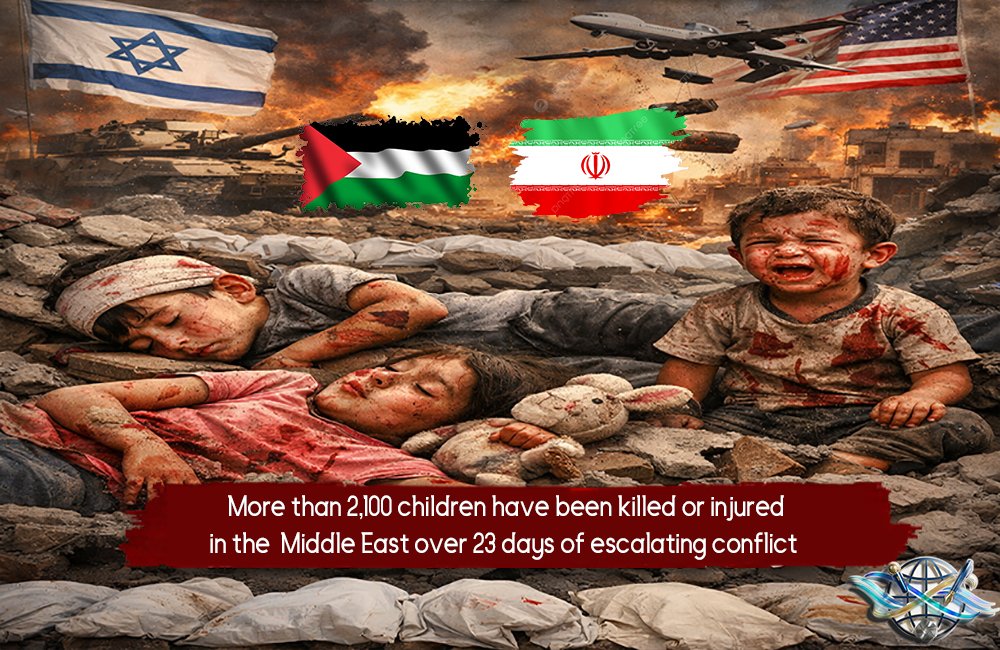
More than 2,100 children have been killed or injured in the Middle East over 23 days of escalating conflict — including 206 children in Iran, 118 in Lebanon, four in Israel, and one in Kuwait — according to UNICEF Deputy Executive Director Ted Chaiban. He warned that these numbers are likely to rise as the violence continues.
Ted Chaiban stated: “This means an average of about 87 children are killed or injured every day since the start of the war,” emphasizing that children in the region are paying a heavy price, and that any slide toward a wider and longer-lasting war would be catastrophic for millions more.
He called on all parties to exercise maximum restraint and protect civilians at all times, adding: “Schools are not targets. Hospitals are not targets. Children are not targets.”
The UN official made these remarks while speaking to journalists in New York on Monday, following a visit to Lebanon.
A classroom lost every day in Lebanon
In Lebanon, he reported 118 children killed and 372 injured since the escalation began, saying: “If we add these numbers together, it equals a full classroom of children being killed or injured every day.”
He noted that behind these numbers are “parents, grandparents, teachers, brothers and sisters, communities, cities, and countries living in shock,” amid large-scale displacement due to bombings and evacuation orders.
According to UNICEF estimates, up to 3.2 million people have been displaced in Iran, while over one million people have been displaced in Lebanon, including 400,000 children, roughly one-third of the displaced. Around 90,000 Syrians have returned to Syria since the outbreak of the conflict, alongside thousands of Lebanese.
Chaiban highlighted that approximately 44.8 million children were already living in conflict-affected areas before the current war, warning that “the consequences of what is happening now will be long-term,” with homes, schools, and hospitals damaged or destroyed, and health systems nearing collapse.
Additional layers of suffering in Lebanon
In Lebanon, Chaiban described the situation as worsening severely, noting that the country is already dealing with cumulative crises, and the current escalation “adds deep layers of impact on children.”
“For the families we met, this is the second time in 18 months that they have been forced to flee,” he said.
Between 200 and 350 public schools are currently being used as shelters, disrupting education for approximately 100,000 students. “Schools provide more than just education… they offer structure, protection, and continuity,” he warned, adding that closing them deprives children of essential elements of stability.
Chaiban shared the story of a young girl he met in Beirut:
“I met Fatima, 15 years old, who fled with her family from the south to the same school they had sought refuge in 18 months ago. She told me that the night before I met her, she stayed awake listening to the bombing in the southern suburbs of Beirut, worried about her family, friends, and future. She and many others wish to return to their homes and schools.”
Limited humanitarian response vs. rising needs
Chaiban confirmed that UNICEF and its partners have expanded their response, reaching 151,000 displaced people in more than 250 shelters, and providing water and sanitation services to 188 shelters serving around 46,000 people.
Approximately 13,000 children received educational materials, while 14 children were treated for critical injuries requiring emergency surgery. Food and health aid were also delivered to thousands of families in southern Lebanon, despite difficult access.
However, he stressed that “the scale of need is increasing faster than available resources,” particularly with over a million people displaced in a short period.
In this context, he referred to the UN’s urgent humanitarian appeal for $308 million, noting that UNICEF’s share of this appeal is $48.2 million for three months, yet the funding gap reaches around 85%.
Urgent call to action
Chaiban concluded by urging the international community to take three immediate actions:
- Cease hostilities and protect civilians and civilian infrastructure.
- Ensure safe, rapid, and unhindered delivery of humanitarian aid.
- Provide urgent financial support to sustain the response.
Discover more from المنتدى الدولى للصحافة والإعلام
Subscribe to get the latest posts sent to your email.