
 Dr. Hany Khater – President of Global Forum for Journalism and Media (GFJM)
In a legal and political development considered one of the most significant in Canada in recent years, hearings began this week before the Supreme Court of Canada to review appeals against Quebec’s state secularism law, known as Bill 21.
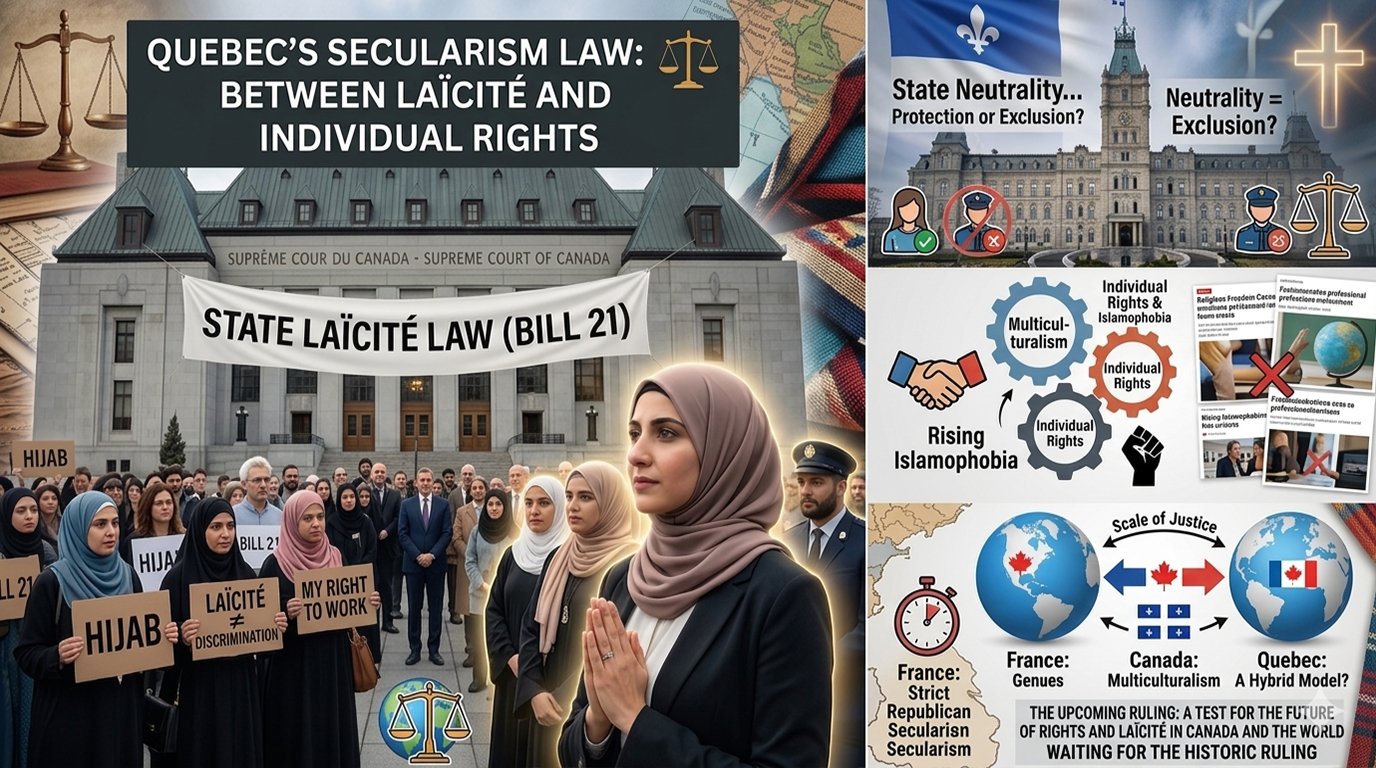
The case, which started as a local debate over wearing religious symbols in public employment, has today turned into a profound constitutional battle that could redraw the boundaries of rights and freedoms across Canada and spark a sensitive discussion about the relationship between secularism and the rise of Islamophobia.
Critical Hearings Begin with Broad National Attention
The case has entered a decisive stage after years of appeals in lower courts. The Supreme Court is currently hearing extended arguments from governments, human rights organizations, teachers’ unions, and individuals affected by the law’s application.
The importance of these hearings lies in the fact that they do not only discuss the constitutionality of a legal text but also test the philosophy of the Canadian constitutional system itself, particularly regarding the use of the “notwithstanding clause,” which allows governments to override certain fundamental rights.
The large number of interveners reflects the stakes involved, as observers believe the forthcoming ruling could become a legal reference for decades in cases related to rights and freedoms.
A Law Aiming for State Neutrality… but Causing Division
The secularism law was enacted in 2019 to establish state neutrality and to prevent employees in positions of authority, such as teachers, judges, and police officers, from wearing religious symbols while performing their duties.
The Quebec government states that the law reflects a secular model specific to the province, historically developed after the so-called “Quiet Revolution,” which reduced the influence of religious institutions in the public sphere.
However, critics argue that the law disproportionately affects religious minorities, particularly Muslim women who wear the hijab, as well as Sikhs and Jews, potentially limiting their career opportunities in the public sector.
Recent Developments: Individual Stories Bring the Case Back to the Forefront
In recent weeks, new individual appeals have emerged from employees and teachers claiming that the law prevented them from working or receiving promotions due to their adherence to religious symbols.
These cases have highlighted the human dimension of the issue, after it had, in past years, turned into a theoretical legal and constitutional debate. Analysts believe that these daily realities make the forthcoming ruling a decision with direct social impact, not just a legal precedent.
Among these appeals, a notable legal challenge was filed by a teacher from the Sikh community who was asked to remove her turban (dastaar) and carry the religious dagger (kirpan) in order to work as a teacher in public schools. According to a press report, the teacher says that wearing these symbols is not merely a religious outfit but an integral part of her identity and spiritual beliefs, and removing them would be tantamount to abandoning the essence of her personality and religious values.
This lawsuit focuses on whether the law violates religious freedom and fundamental minority rights within a multicultural society, and whether its application can be legally justified under the principle of secularism. The ruling in this case could have wide-reaching implications for religious expression and integration in modern democracies. (timesofindia.indiatimes.com)
Islamophobia at the Heart of the Debate
Questions are rising about whether the law reflects a broader wave of legal Islamophobia in the West. Critics of the legislation point out that:
- Legal neutrality does not necessarily mean neutrality in effect.
- Restrictions on religious symbols actually affect certain groups more than others.
- This could reinforce feelings of marginalization among some Muslims in the labor market.
Supporters of the law, in contrast, reject this connection and emphasize that the legislation applies to all religions without exception, aiming to protect citizens’ trust in the neutrality of state institutions.
International Comparison: Quebec Between Multiculturalism and Strict Secularism
Quebec’s experience is often compared to the French model, where restrictions on religious symbols in schools and public institutions have been imposed for years. The key difference, however, is that Canada has historically been built on the principle of cultural pluralism, while the French model is based on the idea of strict republican integration.
Adopting a strict approach in Quebec represents a tension between two civilizational models and raises deep philosophical questions about the nature of the modern state and the limits of individual freedom.
Core Legal Battle: The Notwithstanding Clause and Democracy
The central question under discussion by the judges is the extent to which provinces can use the notwithstanding clause to override the guarantees of the Canadian Charter of Rights and Freedoms. The clause was designed as a balance between parliamentary authority and judicial power, and some experts fear that its repeated use could weaken the effective protection of fundamental rights.
Supporters of the law argue that parliamentary democracy requires granting elected governments the latitude to embody the local values of their communities.
Potential Impact on Canada and the World
Although the law is specific to Quebec, the forthcoming ruling could have wide national repercussions:
- If the court limits the use of the notwithstanding clause, the balance of power between governments and courts could shift.
- If it upholds Quebec’s position, it could encourage the enactment of similar laws in sensitive areas related to identity and religion.
The decision will also be monitored internationally as an indicator of how Western democracies handle the tension between secularism and religious freedom amid rising populism and Islamophobia.
Philosophical Dimension: The Modern State and Individual Freedom
The case has evolved from a discussion about religious attire to a comprehensive test of the nature of the modern state:
- How can neutrality be achieved without exclusion?
- How are individual rights protected in a multicultural society?
- Can secularism become a tool for symbolic control over society?
- What are the limits of parliamentary democracy versus social justice and equality?
The law reflects a philosophical conflict between legislative authority, prevailing cultural values, and individual rights, demonstrating how seemingly neutral laws can become instruments for defining the shape of society and acceptable identities within it.
What’s Next? Awaiting a Historic Ruling
The decision is not expected immediately after the hearings, as the court will need months to draft a detailed judgment in a case of this magnitude. However, it is certain that the ruling will be a pivotal moment in the development of Canadian constitutional law, a deep test of the future of multiculturalism and secularism, and an important element in the global discussion on Islamophobia and identity politics.
Summary: A Battle Over Values and Identity
The battle over Quebec’s secularism law has shifted from a debate about religious attire in public institutions to a comprehensive test of the modern state: how to achieve neutrality without exclusion, and how to protect freedoms without undermining the shared civic framework.
Between defending state secularism and fearing social effects that could be interpreted as discrimination or Islamophobia, Canadians—and observers around the world—await the Supreme Court’s decision, which could mark the beginning of a new phase in the relationship between democracy and identity in Canada.
Discover more from المنتدى الدولى للصحافة والإعلام
Subscribe to get the latest posts sent to your email.