
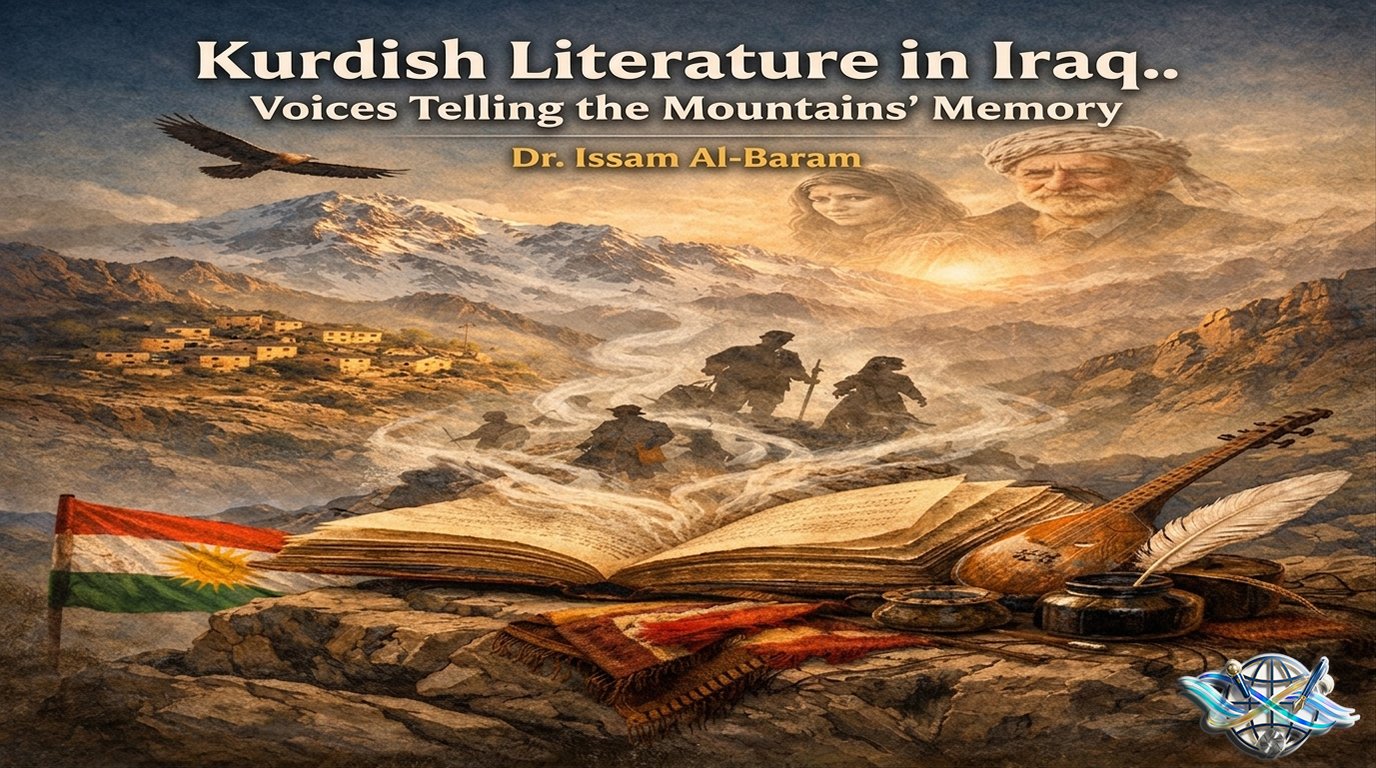
 Dr. Essam Al-Barram
Kurdish literature in Iraq is considered one of the most prominent cultural expressions that has preserved the identity of a people who have long lived through the fluctuations of history and the challenges of geography. It is a literature that emerges from the womb of the mountains, laden with the echo of collective memory, stories of resilience, and dreams of freedom that have not faded despite the weight of decades. When we read this literature, we are not merely reading texts; rather, we are listening to accumulated voices across generations, narrating the story of a people whose features were shaped between harsh nature and turbulent history.
The emergence of Kurdish literature in Iraq has been closely linked to the mountainous environment in which the Kurds lived, where the mountains served as both refuge and fortress, and at the same time a source of poetic and narrative inspiration. This environment was reflected in literary texts, as the mountains became a symbol of steadfastness and dignity, and a witness to the political and social transformations experienced by Kurdish society. Thus, Kurdish literature cannot be separated from place, as this place forms part of its symbolic and emotional structure.
Kurdish literature in Iraq is characterized by the diversity of its forms, ranging from poetry to prose and folk tales. Poetry in particular has been the most prominent and enduring form throughout history. Kurdish poets relied on language as a tool of resistance and a means of preserving identity in the face of attempts at erasure and marginalization. Classical poetry was rich with mystical and emotional themes before later evolving to reflect the concerns of the Kurdish individual and national issues.
With the advent of the twentieth century, Kurdish literature underwent profound transformations, as writers began to move toward realism, influenced by the political changes witnessed in Iraq and the region. Novels and short stories emerged that shed light on the suffering of the Kurdish individual, addressing themes such as displacement, oppression, and loss of identity. Literature was no longer merely an aesthetic expression; it became a critical tool that exposes reality and seeks to change it.
The Kurdish language played a central role in shaping this literature, serving as a means of preserving collective memory. Despite the challenges faced by the use of the Kurdish language during various periods, writers adhered to it as the essence of their cultural existence. This contributed to the creation of a literature rich in local expressions and vocabulary tied to daily life, giving it an authentic and distinctive character.
It is impossible to discuss Kurdish literature without addressing the role of Kurdish women, who have begun to assert their presence strongly in the literary scene. Kurdish women writers have succeeded in conveying their personal experiences and expressing women’s issues within a conservative society, while also offering a different vision of the world where the self intersects with the collective. This feminine presence has enriched Kurdish literature and added new dimensions to it.
Folk tales have also played an important role in transmitting cultural heritage, as generations passed down stories of heroism, love, and resistance. These tales served as an oral record of Kurdish memory, preserving what books could not document. With the development of written literature, these stories became a source of inspiration for writers, who reworked them in modern styles within their works.
Kurdish literature in Iraq is also a literature of exile, as many writers were forced to leave their homeland due to political circumstances. This exile is reflected in their texts, which are marked by nostalgia and a search for roots. In this context, exile became a creative space that allowed writers to reconsider their identity and express it from new perspectives.
In recent years, Kurdish literature in Iraq has witnessed a remarkable revival, with an increasing number of writers, an expansion in publishing, and the emergence of new cultural platforms. Translation has also contributed to transferring this literature into other languages, allowing it to reach a wider audience and interact with different cultures. This has strengthened the presence of Kurdish literature on the global stage.
However, this literature still faces several challenges, including weak institutional support, limited translation, and difficulty in reaching a broad audience both within Iraq and abroad. Nevertheless, the determination that characterizes Kurdish writers, and their ability to transform suffering into creativity, grants this literature a continuous capacity for renewal and survival.
Reading Kurdish literature in Iraq is a journey into the depths of memory, where myth intertwines with reality, and pain coexists with hope. It is a literature that reminds us that culture can be a form of resistance, and that the written word can preserve what might otherwise be lost in the chaos of history. Through this literature, the mountains continue to speak, telling their stories to those willing to listen, carrying within their silence the noise of endless narratives.
Thus, it can be said that Kurdish literature in Iraq is not merely a part of the local cultural scene, but a part of human heritage, given the profound human values it يحمل and the rich experiences it reflects, demonstrating the human capacity for resilience and creativity. It is literature written in ink, yet engraved in the memory of the mountains, where the story continues, awaiting those who will tell it and those who will hear it.
If we delve deeper into the features of Kurdish literature in Iraq, we find that its relationship with history is not merely documentary, but a dialectical one in which memory intertwines with reimagination. The Kurdish writer does not simply recount events as they occurred, but reshapes them through a human perspective that gives them a symbolic dimension, making them relevant across time and place. Here lies the strength of this literature in its ability to transform local experience into a universal human discourse that touches on issues of freedom, dignity, and justice.
The political transformations witnessed in the Kurdistan Region of Iraq in recent decades have also had a clear impact on the structure of literary texts, as they have begun to address new issues such as identity-building under self-rule, the tension between modernity and tradition, and generational conflict. Literature is no longer confined to resistance alone; its themes have expanded to include the details of daily life, social relationships, and existential questions that concern the contemporary Kurdish individual.
It is also notable that Kurdish writers have developed their artistic styles, with the emergence of modern narrative experiences that rely on techniques such as multiple voices, overlapping timelines, and breaking the traditional linear structure. This development has helped make Kurdish literature more open to global experiences without losing its cultural specificity. The modern Kurdish text combines authenticity and innovation, drawing from heritage while remaining open to modernity.
Cultural institutions and universities have also played an increasing role in supporting this literature, whether through academic studies or cultural activities, contributing to consolidating its place within the Iraqi cultural scene. With the spread of modern communication tools, young writers have become more capable of publishing their works and connecting with readers, opening new horizons for Kurdish literature to continue its presence and influence in the future.
Discover more from المنتدى الدولى للصحافة والإعلام
Subscribe to get the latest posts sent to your email.