
 Dr. Hany Khater – President of Global Forum for Journalism and Media
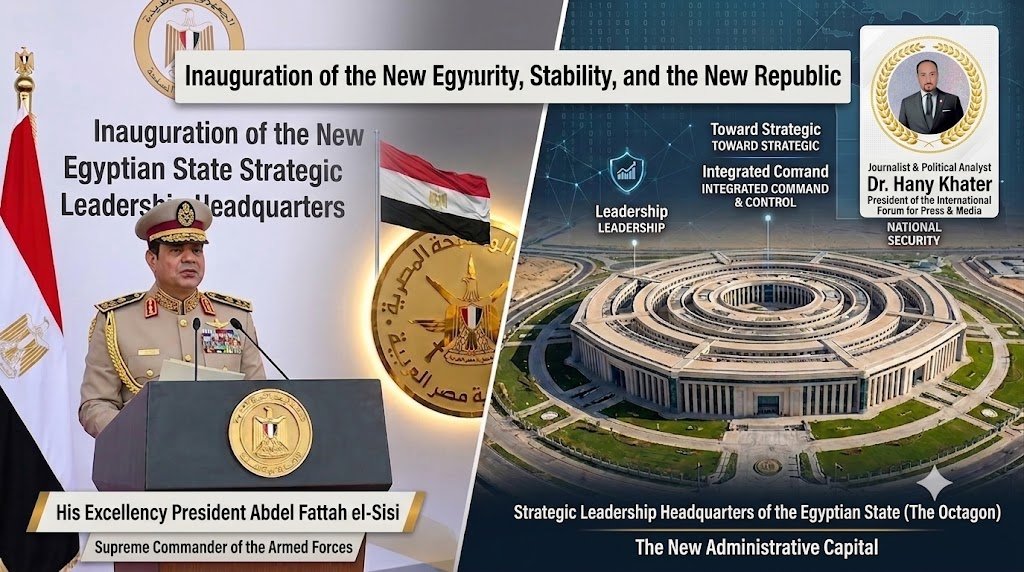
It is not possible to view the inauguration of the Octagon, the strategic command center of the state in the New Administrative Capital, as merely the opening of a new military facility, or the relocation of the Ministry of Defense to a more modern site, but rather it represents a strategic event that reflects broader transformations in the Egyptian state’s philosophy toward managing national security, building its institutions, and enhancing its regional position in an international and regional environment characterized by accelerating changes and multiple sources of threats.
In a world where military power is no longer measured only by the number of soldiers or the size of armament, the ability to manage information, the speed of decision-making, and the integration of command and control systems have become decisive elements in the equation of comprehensive power. From this standpoint, the Octagon comes to express a strategic direction based on employing modern technology in managing military and security operations, and linking the various branches of the armed forces within a unified command system capable of immediate response to various scenarios.
The project gains particular importance in light of the nature of the challenges facing the region. The Middle East and Africa are witnessing rapid changes, including armed conflicts, cross-border terrorism, cyber threats, competition over resources, and the growing influence of non-state actors, in addition to the transformations imposed by fifth and sixth generation warfare, where electronic warfare, artificial intelligence, and the information space have become an essential part of the security and defense system.
In this context, the establishment of a strategic command center that includes advanced data centers, electronic warfare systems, and operations rooms relying on the latest communication and analysis tools reflects an awareness of the nature of modern wars, which are no longer managed from traditional battlefields alone, but through information networks, data analysis, and the ability to make decisions at the right time.
Politically, the inauguration of the Octagon carries multi-level messages. The first message is internal, confirming the state’s continued implementation of major strategic projects within the vision of the New Republic, based on modernizing the institutional structure, enhancing management efficiency, and linking national security with comprehensive development, considering that stability is one of the most important components of economic and social development.
As for the second message, it is regional, and reflects Egypt’s keenness to maintain power balances in its strategic environment, and to enhance its ability to protect its national interests in a regional environment characterized by a high degree of uncertainty. This does not mean adopting an offensive or expansionist policy, but rather affirming the possession of sufficient deterrence tools to maintain security and stability, in accordance with the principles governing Egyptian foreign policy, foremost among which are respect for the sovereignty of states, non-interference in their internal affairs, and adherence to the rules of international law.
As for the third message, it is international, as the project confirms that Egypt continues to invest in developing its sovereign institutions according to the latest global standards, enhancing its ability to participate in efforts to maintain regional security, combat terrorism, secure international shipping lanes, and address cross-border challenges, which have become a shared responsibility among different countries.
From another angle, the choice of the New Administrative Capital as the headquarters for this strategic edifice carries an important political and administrative implication, as it reflects the state’s transition to a more modern model in managing its institutions, based on digital integration, smart infrastructure, and the rapid flow of information, which is consistent with the goals of institutional and administrative transformation adopted by the state in recent years.
The symbolism of the Octagon is not limited to the functional aspect, but extends to the civilizational and cultural dimension. The design inspired by ancient Egyptian architecture, with its architectural elements inspired by the Temple of Queen Hatshepsut and lotus columns, reflects the connection of the modern state with its extended civilizational heritage spanning thousands of years, in a message affirming that development does not mean a break with history, but rather building on national identity within a future-oriented vision.
The octagonal shape of the complex also carries symbolic meanings related to integration and balance, where different functions are distributed within an interconnected system, reflecting the concept of institutional work based on coordination between various specializations and sectors, which is one of the fundamental principles in modern crisis management and military operations.
From a strategic perspective, investment in such projects should not be read from the angle of military expenditure alone, but as an investment in the national security system, which constitutes a fundamental condition for continuing economic development, attracting investments, and protecting critical infrastructure. Security and development are no longer separate paths; rather, each has become directly dependent on the other.
At the same time, any objective evaluation of such projects must be based on a comprehensive reading that takes into account the surrounding security environment, the nature of existing threats, and the actual needs of the state, away from exaggeration or underestimation of importance. Strategic institutions are ultimately measured by their ability to achieve operational efficiency, support decision-making systems, and enhance the state’s readiness to face various challenges.
In conclusion, the inauguration of the Octagon represents an important milestone in the process of modernizing the institutions of the Egyptian state, and reflects a strategic vision based on the integration of technology, institutional planning, and national identity, within a comprehensive concept of national security that links military capability, administrative efficiency, political stability, and sustainable development. Hence, the importance of this project lies not only in its size or architectural design, but in what it represents as a transformation in the tools of state management, and a message confirming that building power in the twenty-first century begins with building institutions capable of absorbing and managing future challenges efficiently and competently.
It can also be supported with statistics, international comparisons, and open references if the forum wishes to present the article in a format closer to an analytical paper or strategic study.
Discover more from المنتدى الدولى للصحافة والإعلام
Subscribe to get the latest posts sent to your email.