
 Jamal Bennoun
At the beginning, the prank was spontaneous, the camera was truly hidden, and the victim was an unsuspecting person who had no idea what fate had in store. We used to watch foreign prank shows and laugh from the heart, wondering how that poor person fell into the trap. The pranks were natural, the costs were high, and the result was impressive. They would build fake stores, hire professional actors, and plan for weeks just for a few seconds of innocent laughter.
There are many international examples proving that this art can be both refined and funny at the same time. One of them is the famous Canadian program “Just for Laughs Gags”, which has been the most famous and widely broadcast since 2000. This show is distinctive because it relies entirely on visual humor without dialogue, making it understandable to any viewer anywhere in the world. It is based on simple, spontaneous situations in public places targeting ordinary people without acting or prior arrangements.
There is also the long-standing American show “Candid Camera,” considered the oldest of its kind, which began on radio in 1970 and targeted both celebrities and ordinary people alike. At the end, the victim would be told that it was a joke and asked to smile.
Among the entertaining programs as well is “Punk’d,” presented by actor Ashton Kutcher, which targeted celebrities only by placing them in provocative situations that could push them to the point of breakdown or tears, as happened with singer Justin Timberlake when he suddenly found himself facing government agents confiscating his house.
There is also “Scare Tactics,” which relies on horror. In this show, producers cooperate with the victim’s family to place them in frightening situations inspired by famous horror films.
Among the unique creative works is “Da Ali G Show,” by British actor Sacha Baron Cohen, who disguises himself as three different journalist characters and interviews real political figures, asking them absurd and strange questions that cause their reactions to range between embarrassment and anger.
In the Arab world, we also had memorable experiences. In Algeria, the first Arab hidden camera program was launched in 1970, directed by Haj Rahim on Algerian Television. In Egypt, the famous show “Al-Camera Al-Khafiya” (Hidden Camera) began in 1983 following the same format as Candid Camera and was presented by the great artist Fouad El-Mohandes. Later, it was developed by the artist Ibrahim Nasr in a remarkable style, who created famous characters such as “Zakeya Zakaria,” the heavy woman, and “Ghabashi Al-Naqrashi,” the Upper Egyptian man. He personally carried out the pranks with people in the street with spontaneity and talent.
In Syria, both Ziad Sahtout and Jamal Shakdouha excelled in presenting wonderful pranks that began as a segment in the program “Television and the People” in 1988 and later developed into an independent program called “From You and to You, Peace Be Upon You” in 1993, which continued for several seasons.
In Tunisia, the program “Al-Timsah” (The Crocodile) was one of the most prominent shows in this field. There was also the program “Maqleb Dot Com,” presented by Ashraf Abdel Baki in 2004. Its idea was unique, as it received emails from viewers requesting that specific individuals be targeted based on their real weaknesses.
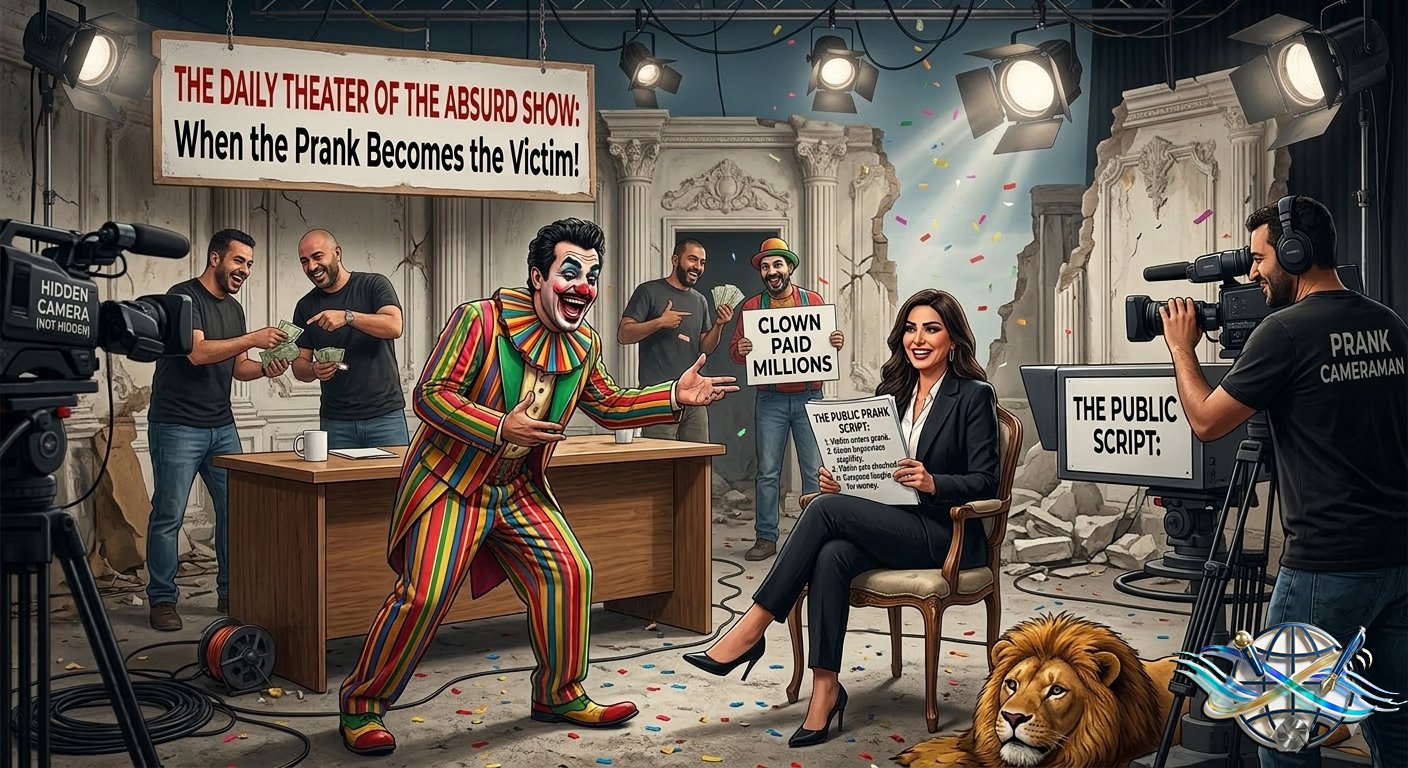
This is the true form of the art of pranks. However, in the Arab world in recent years, things have evolved—backwards, of course. We now have what could be called “the public hidden camera,” or “pre-arranged pranks,” or as I prefer to call it, “the theater of daily absurdity.”
Imagine, ladies and gentlemen, a prank show that has been running for years with the same actor, the same style, and the same method, as if time stopped at the first episode. The viewer already knows that the victim will enter, the host will perform his theatrical gestures, and in the end the victim will discover the trick, become angry—acting, of course—then the host apologizes and asks permission to broadcast the program.
It is as if we are watching a comic play repeated every day, with the same actors participating more than once, as if they were employees of the production company.
What is even more amusing is that the victim knows they are going to film a prank. Yes, you read that correctly: “Come so we can film a prank with you and laugh about it.” The victim goes while knowing every detail. The viewer at home knows, the host knows that they know, and everyone pretends they do not know. It is the conspiracy theory itself—but presented in a weak comedic format.
Even worse, participants receive enormous sums of money. Pranks have become a profession and a job. Some people have specialized in “sacrificing themselves” in these shows and may now be negotiating the fee for the next episode: “I agree to be eaten by a lion, but only if my pay increases by 20%.”
As for the sets, they are extravagant: luxurious palaces, dazzling designs, and huge budgets spent on visual spectacle that leads nowhere, while the victim pretends to be surprised and the viewer pretends to believe it. It is a complete cycle of acting.
In reality, some critics believe that these low-quality programs rely on poor ideas that involve frightening a person, humiliating them, or hurting their feelings. Worse still is that some participants deceive viewers through prior agreements to act and fabricate reactions, which undermines one of the fundamental pillars of real hidden-camera shows: spontaneity and surprise.
The question now is: do we really need such programs?
Do their producers believe that the Arab viewer has become so naïve as to accept anything presented to them? Or do they deliberately try to flatten our minds and underestimate us to this extent?
Consider this repeated scenario: the victim enters the prank, the host performs his acrobatic moves, supposedly “funny” situations occur—quotation marks intended—the victim suddenly discovers the trick with remarkable acting skills, the victim becomes angry—again acting—then the host apologizes, the victim becomes happy and agrees to the broadcast, everyone applauds, and we get a happy ending like a Hollywood film. The only difference is that Hollywood offers creativity, while we offer something I do not quite know how to describe.
After all this, the television channel goes on to purchase more programs of the same type for millions of dollars, as if the Arab market needs nothing but this style of entertainment. Perhaps if they produced a program about how to make real traps, it would be more useful.
In conclusion, we are living in the era of the “reversed prank,” where the victim laughs at the producers, the viewer sympathizes with the channel that spends millions on this level of content, and the actors collect the profits while relaxing on luxurious couches within the program’s lavish sets.
One may wonder: when will we witness a real prank show in which the producers themselves discover that they have fallen into the trap of a spectacular artistic collapse? Perhaps that would be the only prank truly worth watching.
Discover more from المنتدى الدولى للصحافة والإعلام
Subscribe to get the latest posts sent to your email.